
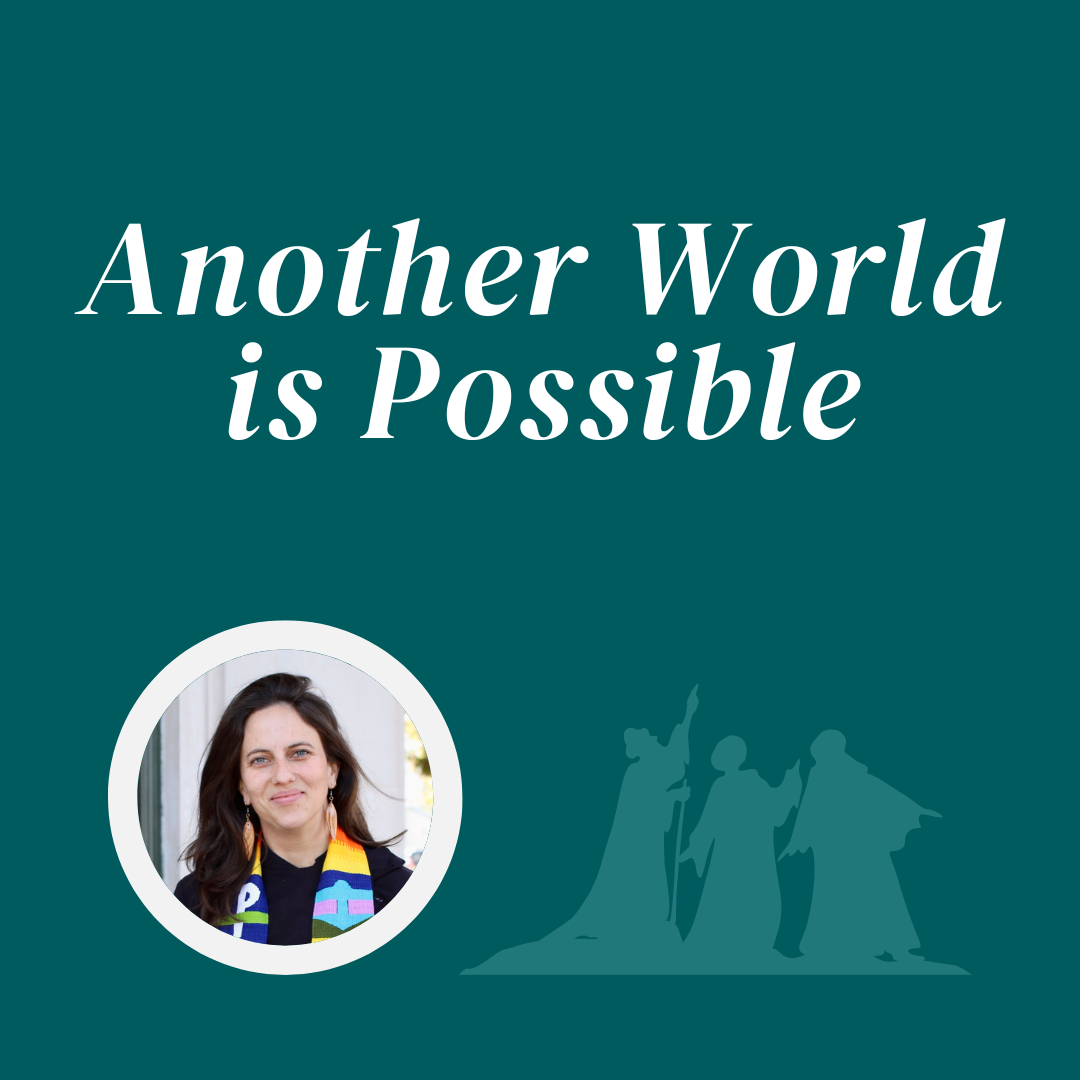
Sermon preached by Rev. Margie Quinn on Sunday, January 11, 2026
On Thursday morning, I woke up with a really troubled spirit. My soul was disturbed, is how I would put it, because the day before, as you know, a woman named Renee Nicole Good — she was 37 years old, the age of Pastor Wesley, a mother of three — was shot and killed in Minneapolis by an Immigration and Customs Enforcement, or ICE, officer in broad daylight. As the officer approached her Honda Pilot, you can see her turning her wheel to the right, away from the agent, before he fired three shots and killed her. Her partner can be seen rushing toward the car and a physician at the scene asked, “Please let me check on her.” But he was refused. In broad daylight on a street in Minneapolis, one of God’s beloved children was taken from us. And if you have felt fear this week, you are not alone. It feels like fear is getting the final say these days as the powers that be — the powers that deport and detain, that threaten us, and yes, even kill — loom large.
In our scripture this morning, we hear that same narrative of powers looming large — of those six words we heard the very first Sunday of Advent back on November 30th when we read Luke 1:5–13. Those six words that said: “In the time of King Herod.”
The words that frame our entire Christmas story. And church, we have to frame our Christmas season in these words. Because as you and I know, the King Herods of this world and of Jesus’ time still loom large in the background or the foreground.
Herod, who represents the worst of what power can do to someone, exists between every line of our Christmas story.
Today, we read that in the time of King Herod, there were wise people from the East who came to Jerusalem to ask about this child who was born a different kind of king. They said he was not King Herod — he was King of the Jews. We often sing about these three wise men in our Christmas season — the three kings who traverse field and fountain, moor and mountain to follow this rising star. And that term “three kings,” magi apo anatolon in Old Persian, simply means “magi from the East.” There’s no specification of gender or number of people or religion. So anytime I can find a woman in scripture, I’m going to find her. In the Zoroastrian tradition, men and women could hold this title. It isn’t a stretch for us to wonder if you and me were some of those magi — this group of people following stars all the way to the birth of Christ.
And then we quickly learn that when King Herod hears of these foreign astrologers coming to pay homage to the child, he is frightened. He is frightened.
What is he so scared of? Why is he so scared of the title of a newborn baby born in a poor town, not in a large city, somewhere insignificant, in a smelly barn? What is he scared of?
He secretly calls for the magi and he wants to know the exact time that they saw this star appear in the sky. Then he says, “Okay, go to Bethlehem. Find this child. Tell me when you have found him so that I may pay homage to him as well.” Deceit at its finest. So they set out obeying what he tells them to do and they follow this star until it stops right over the place where Jesus was born. And when they see this star stop in Bethlehem in this broken-down barn in a poor village, guess what Noah just read? That they were overwhelmed with joy. That in the midst of fear looming large, they were overwhelmed with joy.
When was the last time, church, you were overwhelmed with joy?
When these men and women get there and they see Mary with Jesus, what did we just hear? They immediately kneel. They kneel when they see this baby, in awe and obedience to another kind of king.
And here we get this really neat imagery that you and I know well in our Christmas pageants, that we’ve sung hymns about. They open their treasure chests and what are the three things they offer? Ready? Gold.
I’ve never known what myrrh is. But gold — maybe for a different kind of royalty. Frankincense — this fragrant resin used in incense and perfume, maybe the same perfume that Mary Magdalene used when she took her hair to Jesus’ feet before he was crucified. I wonder if it was that frankincense. And myrrh — which is this sort of gummy resin that’s used as an anti-inflammatory and treats wounds. Did they know Jesus was going to be wounded when he was beaten and flogged by empire? Did they know he would need myrrh for the harrowing journey ahead?
In any case, after they give these gifts, they spend the night, and in a dream — there are so many people who are visited in dreams — they are warned not to return to Herod. And I love this verse. Ready? “So they left by a different road.” They left by a different road. Having seen what they saw, having been overwhelmed with joy, having knelt at the Christ child, they return home by a new route, a new way, possibly this new transformed life. Perhaps believing that in the midst of this power-drunk king and empire that was using coercion and control to threaten its people, in the midst of all that, perhaps they choose to believe that another world is possible.
On this day, we celebrate Epiphany. And so we might ask ourselves: what kind of epiphany provoked these wise men and women to go down a different road than the road of Herod? You know — a different road, church. Reverend Dr. Boy Lee writes: “Epiphanies, they’re not always warm and personal. Sometimes they’re disruptive. Sometimes they’re dangerous. Sometimes they lead to confrontation with empire. Sometimes they ask us to cross borders. Sometimes they send us home by another way. They ask something of us, church. Will we move the way fear makes us move? Or will we move the way love calls us to? Will we move the way fear makes us move? Or will we move the way love calls us to?”
So on Thursday morning, when I wanted to move the way fear was making me move — when I woke up with rage — I reached out to Pastor Wesley and he said, “There’s a vigil taking place at the ICE facility not far from you, not 10 miles from here, and it’s this morning — Thursday morning — and I don’t know who’s going to be there, but come.” So I met him there, where over a hundred people gathered — clergy, United Methodist and UCC, Disciples of Christ and United Church of Christ clergy, teachers, students, all kinds of folks. And we gathered and we lit candles and we shared stories of heartbreak and pain. And we lamented together and we sang songs. And between every story shared — by people who have had siblings deported, by people who volunteer tirelessly to protect the most vulnerable in our community — a woman leading this vigil asked everyone to repeat: “Another world is possible.” Will you say that with me? Another world is possible.
Saying that, I think, is its own kind of epiphany. Saying that insinuates that fear looms large in Herod’s world. But we believe it doesn’t stop us. We believe it doesn’t get the final say. We believe that love leads us forward. And we believe that we are here to work toward another world — a world where we follow the one who wasn’t born in Jerusalem but Bethlehem; the one who is hailed not by the religious elite but by Gentile astrologers; the one who’s not protected by armies but by dreams, by a refugee father; the one who wasn’t visited by government officials or palace royalty but by smelly shepherds, by magi like you and me.
That vigil reminded me that the question for us today is not whether fear exists or not. We know it does.
The question is what we do with it. Do we let it stop us? Do we let it paralyze us? Do we let it make us callous and bitter, rageful and vengeful? Or do we let it move us forward?
The birth of Jesus has not silenced the Herods of this world — I wish I could tell you that it has. And they feel perhaps even louder, or so it seems, using their power to intimidate and coerce, to threaten and yes, to kill.
Fear is so loud.
But I can’t stop thinking about that group that we gathered with on Thursday morning in broad daylight, defying empire not with swords but song — singing This Little Light of Mine and begging, crying out, emphatically shouting that another world is possible.
I’m begging you, church. Begging you like the magi who knelt before this Christ child. I’m begging you not to let fear stop you. Don’t let it take your hope. Don’t let it take your love. Don’t let it take that gospel spirit in you that knows that the inbreaking of the kingdom of God is all around us. Don’t let it have the last word. Look to the magi who sprinted toward that guiding star, who refused to let fear be the end of this story. And so, if you must gather, and if you must lament, and if you must sing, and if you must pray fervently, and if you must use your hands and feet to be Jesus out in this world —
Because we place our loyalty with the most surprising thing of all: with this unexpected baby, this different kind of king, whose title scared the man with the most power, whose birth led the magi to proclaim: “Star of wonder, star of light, star with royal beauty bright. Westward leading, still proceeding, guide us to thy perfect light.” Still proceeding. That’s what I’m writing on my hand this week. With hope, they proceeded. With hope, they placed one foot in front of the other. They knew what we know. They knew what we choose to work toward when we follow this man. They knew that we’ve got to believe and work toward a world where good news is louder than fear. And none of us are off the hook.
Love, not fear — it gets the final say. Love gets the final say. I promise it does. And another world is possible. I promise it is.
May it be so. But we’ve got to make it so. Amen.