
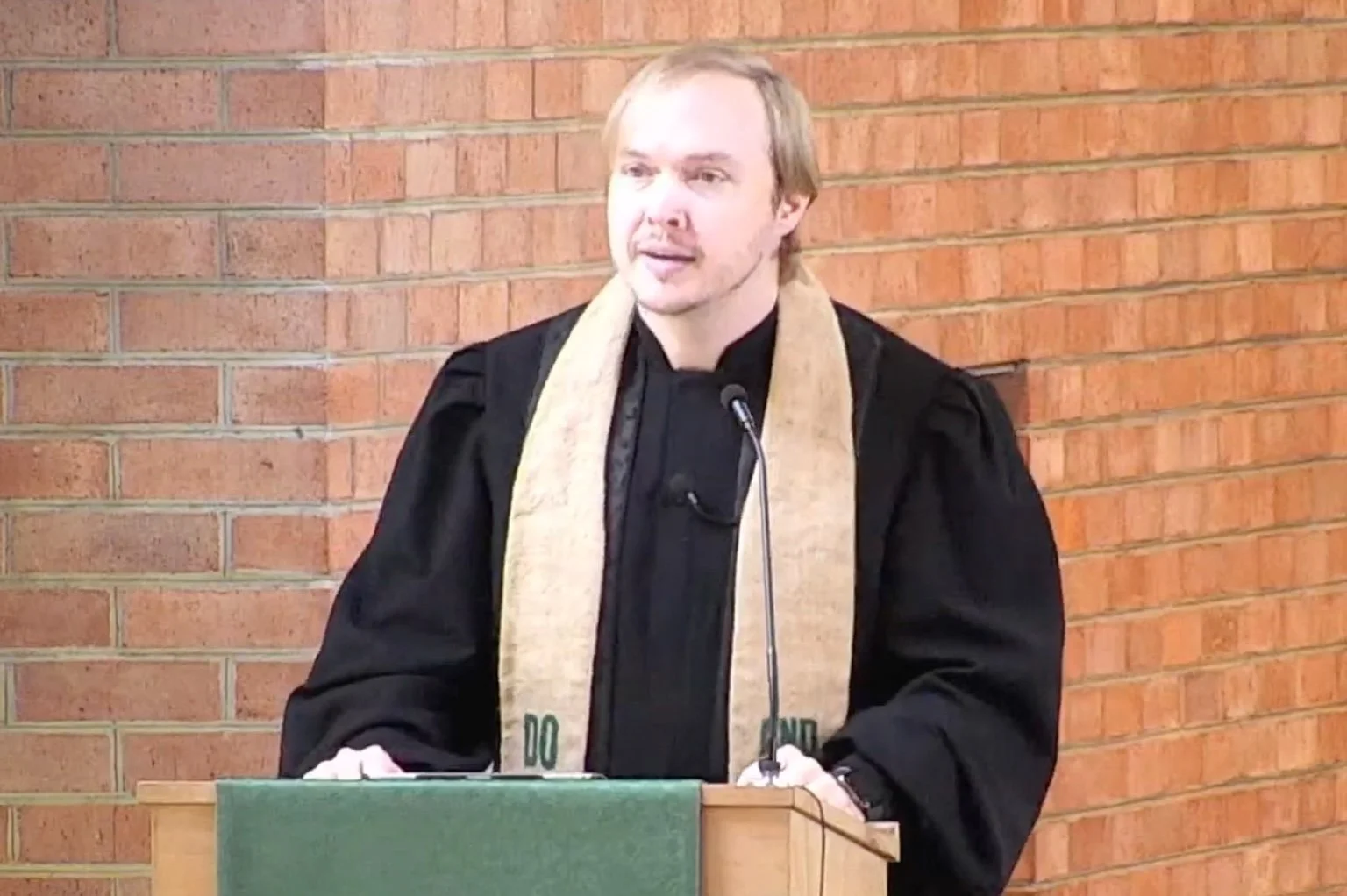
Sermon preached by Rev. Wesley King on Sunday, October 4, 2026
Good morning. If you've been here for the last couple of weeks, you know that we just spent four weeks in the book of Revelation. And personally, I really enjoyed that study because revisiting these books of the Bible that we don't spend a lot of time in and kind of reclaiming those books from those who would use it to instill fear, conformity, and power has been really, really empowering for me. And now we're about to spend three weeks in the book of Exodus. And while we didn't know what the world would look like when we planned this, I can't think of a more perfect transition.
Because as we said, Revelation was never written to help Christians escape the world. It was written to help Christians see the world more clearly. Revelation refuses to let us look away. It pulls back the curtain. It exposes the realities that we've learned to easily ignore, and it wakes us up. It was written to those seven churches in Asia Minor, as you might remember, that had become comfortable with the way things were. Churches that were tempted to accommodate injustice, churches that had settled into apathy, while systems of violence and oppression carried on around them. And John's message to them was, "Don't worry, you'll get out of here soon." His message was, "Wake up. Pay attention. God is at work, and God is calling you to be faithful now."
And that perfectly brings us to the book of Exodus. For many of us, the Ten Commandments are familiar. We know them as rules. We know them as laws. We know them as religious obligations that we've heard since growing up. But before God gives a single commandment, God says something else. God says, "I am the Lord your God who brought you out of the land of Egypt, out of the house of slavery." So this text doesn't begin with the rules. This text begins with liberation.
God is speaking to people who have known oppression. People who have lived under a system where some lives mattered more than others. Systems where people have experienced violence and exploitation and fear. And God says, now you are free. This is what freedom looks like. This is how a community of justice and dignity and belonging lives together. These commandments teach us what life looks like when God rather than fear holds power. They teach us what society looks like when human beings are treated as sacred. They teach us that neighbors matter, that workers deserve rest, that truth matters, that families matter, that life itself matters.
So, as we begin this three-week series on exploring Exodus, it's worth remembering where the Israelites were when they heard these commandments and what events took us and led us to this place. Because these commandments were not given to a comfortable people or a settled people. They were given to a people who were on a journey. A people who were learning to live in freedom after generations of bondage and slavery.
You see, after celebrating their deliverance at the Red Sea with songs of praise, they quickly faced the hardships of the wilderness together. They complain about the bitter water and the hunger and thirst that they experienced. And again and again and again, God responds with provision for them, making the water drinkable, sending manna and quail for food, and bringing water even from a rock. Along the way, they are attacked by the Amalekites, but they are sustained through God's help. Jethro, who you might remember from the movie Prince of Egypt, is the father-in-law of Moses, and he advises Moses to share leadership responsibilities so that the community can learn to flourish together.
Finally, in the third month after leaving Egypt, 90 days later, the Israelites arrive at Mount Sinai, and there God reminds them that they have been carried on eagles' wings out of Egypt and invites them into this covenantal relationship with God. The people prepare themselves amid thunder and lightning and smoke and this trembling earth. This really dramatic scene, and God descends upon the mountain, setting the stage for giving of the Ten Commandments that we read this morning.
This is again a people who are learning to trust God in freedom. And so God reminds them who he is. And God gives us these Ten Commandments that so many of us learned growing up. Have no other gods before me. Make no idols. Do not use the Lord's name in vain. Remember the Sabbath. Honor your parents. Do not kill. Do not commit adultery. Do not steal. Do not lie. And do not covet.
What I really love so much about revisiting these books, as I mentioned, such as Genesis in June and Revelation last month and now Exodus this month, is that we get to revisit these texts that we've heard a thousand times and perhaps learn something new about them. Perhaps something that we didn't learn when we were younger, or perhaps something that we weren't ready to learn until we had experienced life as an adult. So let's walk through these commandments again, maybe with new eyes this time.
Number one, have no other gods before me. In the ancient world, other gods were often linked to empires and military power, wealth, and social hierarchy. Today, our gods may take different forms, such as nationalism, greed, consumerism, perhaps political ideology, white supremacy, the things that we hold on to in our systems. Systems that demand ultimate loyalty while harming God's children. These modern idols promise security and identity, but often at the expense of justice and human dignity. So this first commandment asks us whether our deepest loyalty and where it is and where it lies. Will we follow the God who liberates the oppressed or the gods of profit and exploitation? Will we serve the God who hears the cries of the vulnerable or the gods of wealth and power and domination? Will our allegiance belong to God's beloved community or to those systems that other and dehumanize?
Number two, make no idols. The second commandment warns us about idols. And we often hear that word and we think of golden calves or carved statues or ancient temples, but idols are not confined to the ancient world, are they? An idol is anything that we create and trust more than we trust God. An idol is anything that claims our loyalty and shapes our identity and demands our devotion. Wealth can become an idol. Political power can become an idol. Nationalism can become an idol. Even religion can become an idol, when we begin to worship our idea of religion, our image of God, rather than the living God.
The dangers of idols, though, is that they always make God smaller. Idols reduce God to something that's manageable, something that we can control and possess, something that we can use to justify our own agendas, something that we can easily overlook or ignore. This week, the Secretary of War stood in front of military leadership and our brave folks in uniform and said that we are fighting a war against religious fanatics. And then he went on to quote scripture more than he did military strategy. Meanwhile, this senseless war continues. You see, we love to create a God who looks like us, who thinks like us, who votes like us, who blesses everything that we already believe. But the living God refuses to be contained by our own assumptions or by our ideologies or our fears. The call of this commandment is to let God be God. Refusing to bow before any image, ideology, or institution, or power that demands devotion that belongs to God.
Number three, don't use the Lord's name in vain. I remember getting popped when I was little. Popped every time I said, "Oh my God," instead of, "Oh my gosh." Anybody else? You got the scars to prove it. As if God really cared about the difference of those three little letters. As an adult, I know that while, yes, language does matter, that is an extreme oversimplification of what that commandment is saying. We were told that it means not cursing or not swearing or not speaking God's name carelessly. But this commandment is about far more than just words.
In the biblical world, a name represented a person's character, a person's reputation, and their identity. To bear God's name meant that you represent God before the world. Let me say that again. To bear God's name meant to represent God before the world. So the real question is not how often we say God's name, but how faithfully we live in God's name. We take God's name in vain whenever we claim God's authority for things that contradict God's character. We take God's name in vain when we use religion to justify prejudice or exclusion or oppression or violence. We take God's name in vain when we speak of God's love while refusing that love to our neighbors. We can avoid every swear word in the world and still break this commandment every day.
Number four, keep the Sabbath. Now, here's where I'm preaching to myself, y'all. If you know me, I'm not content unless I'm doing three too many things at once. This commandment reads like this in the NIV version: "Remember the Sabbath day and treat it as holy. Six days you may work and do all your tasks, but the seventh day is the Sabbath to the Lord your God. Do not work on it. Not you, not your sons or daughters, or your male or female servants, not your animals, or the immigrant who's living with you."
The commandment to remember the Sabbath is about more than just taking a day off. It declares that our worth is not measured in our productivity. The Israelites had been slaves in Egypt. Right there, their value was defined by how much they could produce. But by giving them Sabbath, God taught them a new way of living. That they were no longer slaves, but free. And notice too that the Sabbath is not reserved for the powerful or the wealthy. It's for everybody. Everyone is included. Children, servants, immigrants, even animals. Sabbath is one of the Bible's most radical visions of justice, because everyone is entitled to rest. It reminds me that God's kingdom is not built on endless labor and exhaustion or expectation.
So perhaps the Sabbath question asks us this: Are we living as a free people, or are we still serving the idols of productivity, achievement, and busyness? Ouch, that one hurt. Are we living as a free people? Are we still serving the idols of productivity, achievement, and busyness? I know I am. But this commandment invites us to resist a world that tells us that our value comes from what we do, and instead to remember that our value comes from what God gives us, who we are.
Number five, honor your parents. The commandment to honor our father and mother is often heard simply as just obedience, right? But it's really about sustaining healthy relationships and communities across generations. In the ancient world, honoring parents meant recognizing our responsibilities to one another and ensuring that our elders, our families, our communities were cared for rather than abandoned. This commandment calls us to build a society where people can age with dignity, where families have the support that they need to flourish, and where we learn from those who came before us while also preparing this world for those that come after us. Honoring our parents is not about blindly accepting what they say or do, but rather about recognizing our interconnectedness with them and taking responsibility for one another and each other's well-being.
Number six, do not kill.
Sometimes things happen in the world that forces us to pay attention, don't they? This week was one of those moments for sure. Across Tennessee, many people found themselves talking again about life and death, justice, punishment, and what it means for a society to take a human life. The attempted execution of Christa Pike brought difficult questions back into public view. Questions about accountability, about mercy, about whether redemption is possible. Questions that many of us and many in our society would rather not think about.
I'd say Christa Pike, who did do something unimaginable and inexcusable in 1995 when she took the life of Colleen Slemmer, has spent nearly 30 years on death row. And despite several other botched executions this year, they proceeded with lethal injection this past Wednesday. The execution descended into chaos when Pike, who's aged 50, survived two rounds of lethal injection drugs and was rushed to the hospital. Her attorneys on October 2nd said that she was unconscious and on a ventilator. "Hospital staff are working to save Ms. Pike's life and clear the pentobarbital from her system," her attorney said on Friday, comparing pentobarbital to bleach and Drano. It's caustic and highly alkaline and burns upon contact, including skin, tissue, and veins. And apparently at no point did any member of the execution team realize that the IV lines were not correctly placed, or that the veins had blown and the pentobarbital was in whole or in part entering Ms. Pike's body.
A catastrophic failure on Wednesday that caused Frank Strada, the commissioner of the prison system, to resign right as they are opening an investigation. And one would think that after this gruesome, inhumane treatment, you would think that you might see the complexity, the expensiveness, the sickening truth of state-sanctioned murder as a sign that perhaps we don't need to be taking a life. And yet the woman who is most likely to become our governor made bringing back the electric chair a campaign promise. God help us.
You see, we love to cite "do not kill" when it comes to abortion, and apparently abortion only. Not when it comes to genocide across the globe. Not when it comes to the wars that we start. Not when it comes to the 52 people who've died in ICE custody. Not for the 18 migrant miscarriages that have occurred in ICE custody. Not when it comes to the 256 transgender lives lost last year to violence. But friends, "do not kill" says that every human life is sacred, because every single person bears the image of God. We do not get to assign worth based on what they've done or who they are, where they're from, if they've come here legally, because they have been claimed by God.
Number seven, eight, and nine. Do not commit adultery. Do not steal. Do not bear false witness. I think these are pretty self-explanatory. All of these are about honoring the dignity of others while protecting the trust that makes community possible and those relationships possible. In each case, the harm extends beyond just an individual act. It weakens the bonds that hold us together. These commandments recognize that healthy relationships and communities are built on mutual respect, integrity, and faithfulness.
Under these commandments, young men should know that they can never violate a young woman unconscious in such a disgusting way as the Cornell 7 did. And furthermore, under these commandments, the powers that be know that they cannot make excuses for them. They cannot assign them essays instead of jail sentences. They cannot worry about these young men's futures, but not the safety of these young women on their campuses. These commandments call us to reject every form of exploitation. They call us to be trustworthy in our relationships and equitable in our dealings with others. At their core, these commandments ask whether we are treating people as gifts to be cherished or objects to use.
And finally, number ten, do not covet. This commandment moves beyond our actions and into desires. While the other commandments focus on what we do, this one asks us to examine what's happening in our hearts. Coveting begins when we become consumed by something that belongs to someone else, whether it's possessions or status or success or relationships. And I think growing up, we all thought this was just wanting other people's stuff, right? I admit I've coveted Brock's boat. It's a beautiful boat. He's since sold it, unfortunately, but I coveted it for sure. I coveted the $39.5 million house I saw in Zillow the other day in Fort Lauderdale. Looked beautiful.
But after going through these today, I think we all know that it's so much more, so much deeper than just wanting other people's stuff, right? This commandment challenges a culture that constantly tells us that we are incomplete, that we need more to be worthy or successful or happy. It calls us away from scarcity and comparison and greed and invites us instead into gratitude and generosity and contentment. Rather than viewing others as competitors or their blessings as threats, we are called to celebrate one another's flourishing and work towards a community where everybody has enough. God's vision of this world is not defined by endless wanting, but by a beloved community that is shaped by gratitude and generosity and mutual care.
So perhaps that's the question before us this morning. In a world still marked by violence and division and injustice, will we treat these commandments as ancient words carved into stone? Or will we hear them as God's living invitation to become a different kind of people, now, here? Because these commandments were never merely about personal morality. They were about forming a beloved community. A people who worship God instead of idols. A people who tell the truth. A people who honor one another's dignity. A people who rest when they need it. A people who honor life. A people who reject greed and exploitation and violence. A people who reflect God's dream for the world.
So hear this charge this morning, and think about these things as we reflect on the book of Exodus this month: that the God who spoke at Sinai is still speaking now. The God who spoke at Sinai is still calling us now. Calling us away from idols of power and fear. Calling us away from the lies that divide and dehumanize. Calling us away from the violence that wounds God's vulnerable children, and instead is calling us towards justice, calling us towards mercy, calling us towards beloved community. So maybe the question is not, is God still speaking, but instead, are we awake, and are we ready to hear it?