

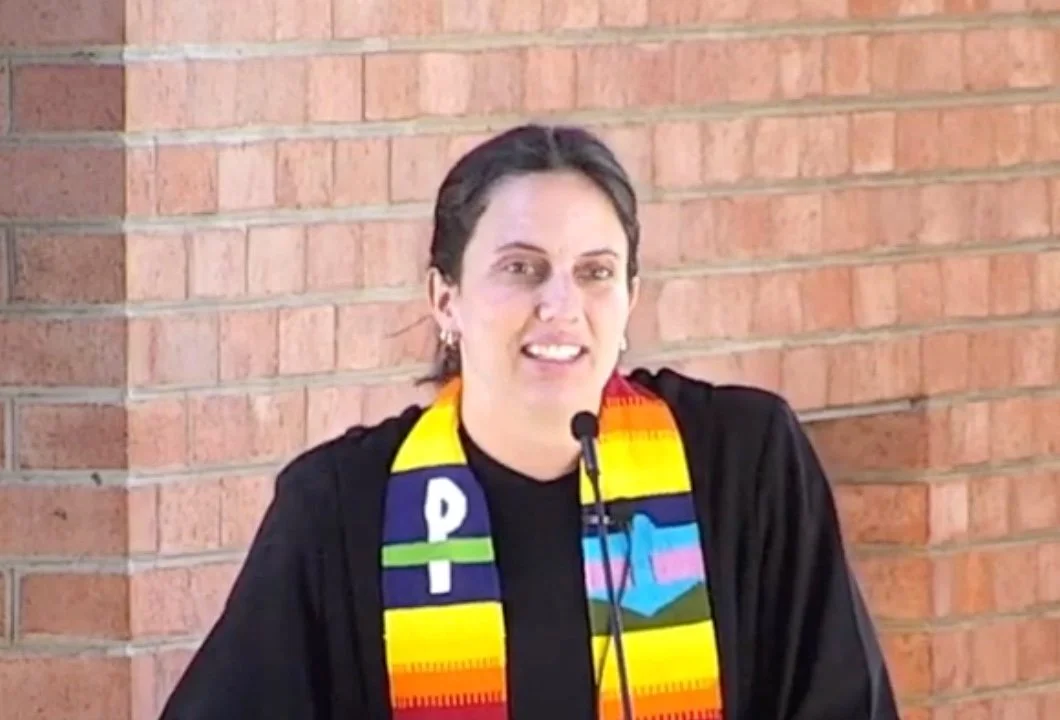
Sermon preached by Rev. Margie Quinn on Sunday, November 15, 2026
One of my favorite movies is Dead Poets Society. This movie was actually written by a guy that went to Montgomery Bell Academy, the school next to ours. And in some ways, it's based on an all-boys private school that demands pretty rigorous academics, which is true for a lot of schools, I feel like, more and more. In this movie, this kind of rigid, formal school hires a pretty unorthodox English teacher, played by the late, great Robin Williams. His name in the movie is Professor John Keating. And he challenges the students to throw out how they think they should be and to lean into a life in which they are invited to seize the day, to carpe diem, to live deliberately, and to suck out the marrow of life. Pretty soon his students are so enthralled by his style of teaching, and they begin to feel the freedom to be all of who they are. Particularly a student named Neil Perry.
Neil is the victim of suffocating demands by his father. His dad wants him to go pre-med. His dad wants him to focus on his studies. And so his dad makes him quit all of his extracurriculars that give him life. But Neil loves acting. He loves acting. And he wants to be a performer. He wants to step into the roles of different characters, to live into these different roles that he might get to play. And so, with the encouragement of Professor John Keating, he auditions for a role at the community theater, where they're putting on A Midsummer Night's Dream. And he gets it. He gets the role of Puck. The joy that emanates from him in that scene is palpable.
So he has to call his father and tell him. And so, with trepidation and boldness, he tells his father that he's going to be in the play, to which his father responds, "You will quit the play."
He comes to Professor Keating to tell him about the exchange. He says, "I just talked to my father. He's making me quit the play. Acting is everything to me, but he doesn't know. And I can see his point. We're not a rich family. But he's planning the rest of my life for me, and he never asked me what I want."
Professor Keating says, "Have you told your father what you just told me about your passion for acting? Have you ever showed him that?"
"I can't."
"Why not?"
"I can't talk to him this way."
"Then you are acting for him, too. You're playing the part of a beautiful son. Now, I know this sounds impossible, but you have to show him who you are, what your heart is."
"I know what he'll say," Neil responds. "He'll tell me that acting is just a whim and I should forget it. He'll tell me to just put it out of my mind for good."
"You are not an indentured servant," Professor Keating says. "It is not a whim for you. You prove to him by your conviction and passion. You show that to him."
"No, I can't. What about the play? It's tomorrow night."
"Then you have to talk to him before tomorrow night."
"Isn't there an easier way?"
"No."
"I'm trapped."
"No, you're not."
Neil goes on to offer a masterful performance in this play in the role of Puck, receiving a standing ovation despite his father's demand that he bury his talent.
This passage that JT just read, this is the third parable in a row in the Gospel of Matthew in which Jesus is speaking to the coming of the Son of Man. This story he tells is in the last week of his life, the last week of his ministry. And in all three parables (Wesley preached on one last week), he is trying to communicate a sense of urgency. Tensions are high. People want him killed. He is the enemy of almost everybody else. And he is desperate to communicate to them, "When I leave, be ready for my return. Keep awake. Stay alert. Take oil for your lamps. For we know neither the day nor the hour."
And his audience at this time, they thought he was coming back at any minute. Any minute he might come back. And so his teachings are a way of telling them how they should live in the meantime. Matthew is speaking to the church at this time. And there are people in the church (let's say this side of the church) that are faithful and good. And then there are people on this side of the church (let's say—sorry, y'all, I didn't choose it) who are wicked and lazy. And so Matthew is trying to answer this question: How does Jesus want us to live in the meantime? Faithful or lazy?
Now, a word about this story. Slavery was seen as normative in that time. This allegory really wouldn't have made people bristle or feel disturbed in a way that it does, and should, for us today. So we've got to hold both of those things.
So, this story: A master goes on a long journey, perhaps as Jesus knew he would soon, and he gives a different amount of talents to three of his slaves. The first slave he gives five talents. And just a word here: one talent in this time was equal to 15 years of work. So five talents is that man's entire life. The first man gets five talents, the second gets two, and the third gets one. This guy gives his slaves talents, each according to their own ability. They didn't all get the same amount because they didn't all need the same amount. Different gifts, different talents.
And then the man goes away. And the guy that receives five talents, he takes a risk, and he goes off and he trades his five talents, and he doubles them. Ten talents. The second guy does the same, doubling his from two to four. And the third guy, the one with one talent, he digs a hole in the ground and he hides his master's money. He buries his talent.
And when the master gets home, he checks in on the talents. "How'd we do?" And the first slave shows his work: "I went from five to ten." The second slave shows his work: "I went from two to four." And they receive praise for it. "Enter into joy," their master says. "In fact, because of the risk you took, I want to give you even more responsibility."
These two accounts of the first two slaves, you may have noticed, are almost word-for-word the same narratives, as if these parallel narratives are just a foil for what happens with our main character, the third slave.
When asked what happened to his talent, he says, "Master, I knew that you were a harsh man, reaping where you did not sow, and gathering where you did not scatter seed. So I was afraid, and I went and I hid the talent that you gave me in the ground. Here you go. Take what's yours."
And what follows is pretty harsh condemnation of the man who buried his talent. "You ought to have invested my money with the bankers," the master said, "and on my return, I would have received what was my own with interest."
Author and pastor Reverend John Buchanan points out that this isn't a bad man. This is a careful man. He's just not taking chances on his talents. He might even be proud of himself when the master comes home: "Here it is. All of it, safe and sound. I didn't lose it. I didn't risk anything. I kept it safe." The difference is, he didn't keep it safe out of faithfulness. He kept it safe out of fear. And as Mark Douglas points out, fearing his master, that which he fears is realized. In other words, church, sometimes the God we face is the one we imagine. If we fear God, we may imagine that that God could be harsh with us. But if we believe in a merciful God, perhaps mercy is waiting for us.
I don't think this parable is about doubling your money. I don't think it's about accumulating wealth. I think it has something to do with living faithfully and using our talents in this meantime time. I don't think Jesus wants his followers to bury our gifts and abilities, but to share them. To risk living out the gospel by putting down the shovel that would hide them and picking up a microphone, or a pencil, or a paintbrush, or—thank you, Jesus—a calculator, because we need y'all with calculators.
"The greatest risk of all," Reverend Buchanan writes, "is not to risk anything. Is to not care deeply and profoundly enough about anything. To invest deeply in it, to give your heart away, and in the process to risk everything. The greatest risk of all, it turns out, is to play it safe, to live cautiously and prudently."
Sometimes I think we think of faith as just believing in Jesus, believing in God, having the intellectual capacity to retain the ideas of those two entities, just avoid the bad stuff and kind of understand our own personal theology. That's faith, right?
But faith isn't about knowing. It's about doing. Faith isn't about knowing. It's about doing. It's about following Jesus, who didn't say, "Believe in me." He said, "Follow me. Follow me." Be bold and brave. Don't bury your goodness or love or gifts or abilities in the ground. That's not where they belong.
For those of you who join today, welcome. My hope for you is that you don't bury your gifts, because we need you. This community needs you. We need baby Lizzy. We need Jeff. We need Cat. We need Lisa. We need Mark. We need Shawn. We need Heather. Am I forgetting anyone? We need Hudson. How could I forget Hudson? We need your culinary gifts to make soup next week. We need every single ability and talent that you have to offer. Not to exploit them, but because they enhance this community. They help us follow Jesus and strengthen our faith.
Let me tell you about some of our members that you're joining to be in community with today. We have a member who comes in to do "monk work," as she calls it, where she cleans and tidies, organizes and repurposes. She made that kitchen spotless on Friday. Thankless, gifted work. We have a member who every week hands me an Aldi card to give to those who are in need of groceries. We need him. Some of our members have angelic voices. And some are prophetic writers. Some are exuberant camp counselors. And some are skilled money managers. Thank you, Jesus, for what we're not. Some lighten the mood with your gift of humor. Some enhance the sound in here with your audiovisual knowledge. Some share the ability to sleep on a cot with our guests at Room In The Inn, when very few want to do that job. And some do the thankless work of closing this building and turning off the lights and blowing out the candle when we all leave. Thank God that we have all kinds of kinds. Thank God that we do not bury our gifts, but worship a God who says, "Follow me," bringing exactly who you are, and exactly what you have to offer, and your uniqueness with you.
His last week of life, that's when he's telling this story. And his plea feels pretty clear: Don't bury what I have so freely given you. Instead, as you await my return, do exactly what I told you. Feed the hungry, visit the prisoner, sit with the sick, make soup, break bread, give back, share grace, use your gifts and abilities. Do not bury those talents. This being-a-disciple-of-Jesus thing, it's not about playing it safe, is it, church? It is a high-risk venture, and it is an adventure in faith. A high-risk venture and an adventure in faith.
In one of the most powerful scenes in Dead Poets Society, Professor John Keating speaks to his class about this act, this process of what it means to live in the meantime time. I'm going to replace the word "poetry" here in his monologue with "faith."
We don't practice faith because it's cute. We act out our faith because we are members of the human race. And the human race is filled with passion. And medicine, law, business, engineering—these are noble pursuits and necessary to sustain life. But faith, grace, love—these are what we stay alive for. To quote from Whitman: "O me! O life! … of the questions of these recurring; of the endless trains of the faithless; of cities fill'd with the foolish. … What good amid these, O me, O life? Answer: That you are here—that life exists, and identity; that the powerful play goes on, and you may contribute a verse." What will your verse be?
We don't follow Jesus because it is cute or safe. We do so because we are here, living in the meantime. That the gospel goes on, and that we may contribute a verse, a talent, a gift. What will your verse be, church? What is your talent to offer? Carpe diem, church. Seize the day. Dig your talent up and share it. Don't hide it.
Amen. Amen.