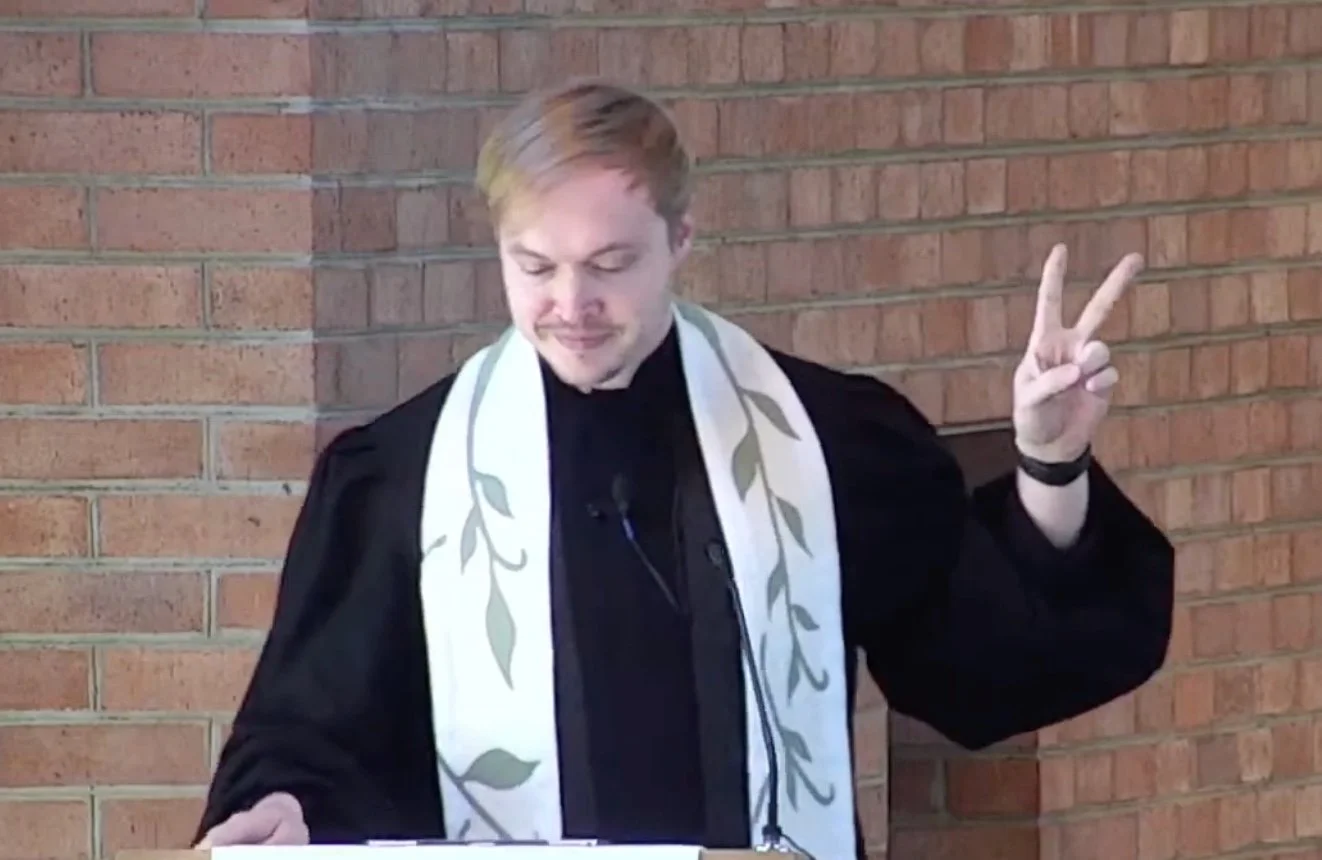
Sermon preached by Rev. Wesley King on Sunday, April 12, 2026
Let me take you to the fall of 2005. Do you remember where you were in 2005? Were you alive in 2005? In the fall of 2005, I’m driving in my little two-door black Saturn SC2. Do you know what that is? That was my first car. And I’m blasting the CD of one of my bands that I was obsessed with at the time, the American bluegrass band Nickel Creek. Anybody remember them? They’re still around, by the way. They had just released their sophomore album, and these are the words that I heard:
"What will be left when I’ve drawn my last breath? Besides the folks I’ve met or the folks who have known me? And will I discover a soul-saving love or just the dirt above and below me? I’m a doubting Thomas. I took a promise but I do not feel safe. Oh, me of little faith."
Chris Thile wrote that song, if you know who that is. The second verse goes on to say, "Sometimes I pray for a slap in the face. Then I beg to be scared or bear—to beg to be spared because I’m a coward. And if there’s a master of death, I bet he’s holding his breath as I show the blind and tell the deaf of his power." I love that line. "I’m a doubting Thomas. I can’t keep my promises because I don’t know what’s safe. Oh, me of little faith."
Let’s pray together.
Holy One, give us the wisdom to hear your words. Give us the wisdom to take them into our hearts and give us the wisdom to act on their truth. For we are listening. We are listening. Amen. Amen.
Now, growing up, I often heard that doubt was a sign that you weren’t right with God. Doubt was a sin. Doubt was a sign that you didn’t try hard enough. You didn’t believe hard enough. You didn’t have a strong enough faith. It was a sign of moral failure. Folks who doubted couldn’t be saved because if you were saved, then you must have believed. So, you couldn’t have had doubt. So there was this fear in even just admitting that you had questions or doubt or you didn’t understand something. That was my experience, at least. Maybe it was yours as well.
I’ve even shared a couple times that after my grandfather passed away, I was sitting with my grandmother and she started asking like, "Why would a loving God let Grandpa suffer? Why would God let Grandpapa suffer so long and why?" And then she gasped. She retreated back into herself and she said, "I’m sorry. I know you’re not supposed to doubt. You’re not supposed to question God." I remember a classmate in college when someone asked if all of this was just a bunch of mumbo jumbo. And she said, "Well, I’d rather believe it and not need it than not believe it and wish that I had."
But even then, as I think back on that, that is belief based out of fear, right? And it’s human nature to have doubts. It’s human nature to question if we want to see it so that we can believe it. God made us these finite beings, these fallible beings. So to expect that we will never sin, that we will never fail, we will never doubt, we will never question is just unrealistic. And yet that is the expectation that so many had placed on ourselves growing up. And so much of that expectation is singular—church placed on the self, right? "You didn’t believe. You doubted it."
I was talking to someone a while back who used to go to church pretty regularly, but amidst the turmoil of life, the rise of Christian nationalism, failings of organized religion, all that’s going on in the world, they said that they just couldn’t step back into church. "I want to get there," they said, "but I’m just not there yet. Can you believe enough for the both of us?"
We’ve been taught that to doubt is a failing of the human experience instead of it being a part of the human experience. We’ve been taught that doubt is a failure of faith instead of it being a part of the faith process. We’ve been taught that doubt is a roadblock to our journey instead of being a part of the journey itself. Yes.
Each week, Pastor Margie and I say something to the effect of, "Whether you are devout or full of doubt, you are welcome here." And we say that because we’re trying to create something new here at Vine Street. We’re trying to help people understand that you don’t belong because you believe. You believe because you belong. I want to say that again. You don’t belong because you believe. You believe because you belong. Meaning, you are welcome here as you are with all that you might bring: your faith, your doubts, your questions, your convictions. And in doing so, our collective faith is made stronger. Why? Because we’re not doing it alone.
Verse 25 says Thomas replied, "Unless I see the nail marks in his hands and put my finger in the wounds left by the nails and put my hand into his side, I won’t believe." But here’s something I want you to think about. Thomas was the only one who didn’t see Jesus from the group the first time, right? He was alone in that. Everyone else claimed to see this miraculous event—that this man that they saw murdered had come back to life. Don’t you think that some of them, even after they left that experience, might have said, "What just happened? What did I just see? Did that really just happen? Am I dreaming? Was any of that real?" And then together they were able to recount, to reassure, and reaffirm what they had just witnessed.
But not Thomas. He was alone. And so I get it. I imagine that Thomas looked at his world as this oppressed person, someone living under a tyrannical regime, under the thumb of empire, and he could not see death defeated. I look at my own world. I look out at the world and I see this senseless war that is somehow won and yet not done. I see this tiny, tiny man who’s trying to convince the world that he is big and bad. I see unfilled potholes in our streets and rising gas prices and failing infrastructure. And yet our concern is denying trans folks healthcare. Our concern is denying kids an education for the little maps that we’ve drawn with lines. Right. I can’t fault Thomas because I too sometimes wonder how or where is death defeated.
But the good news, friends, is that even when I am a doubting Thomas myself, I remember that I have this community of goodness in the world here. A community that helps me remember when it’s hard for me to remember on my own that this is not the end and to hold on a little bit longer. A community that helps me remember that Christ is indeed alive in the world through their love and through their actions. They prove it to me. They help me remember that the kingdom of God is nigh—and not in this apocalyptic way, but in the sense that we are bringing heaven to earth. Yes. And that we don’t have to do it alone.
Even after this miraculous interaction that they had with Jesus, the disciples doubted again, right? How could they not? They’re human. In fact, I invite you to go read in Matthew’s gospel, chapter 28:18, where they even had doubts at the ascension. There were some who, yes, believing became easy to them. But for most of them, especially in these post-resurrection stories, it didn’t. And their first response was doubt and fear.
Jesus said, "Thomas, put your finger here and look at my hands. Put your hand into my side. Stop doubting and have faith." Thomas replied, "You are my Lord and my God." And Jesus said, "Thomas, do you believe and have faith because you have seen me? Because the people who have not seen me but still have faith are the ones who are truly blessed."
Commentator Jim Harnish, he shares these words about this story. He says, "My guess is that the early church preserved this story about Thomas not because it was peculiar, but because it was familiar to them. They were not so unlike us in confronting oppression and injustice, racism, corruption, and dishonesty in our world." But don’t miss the words that acknowledge their doubt, too. Because it says, "Although you have not seen him, you love him. And even though you do not see him now, you believe in him." He says that in and through their doubt, they experienced a new birth into the living hope through the resurrection of Jesus Christ. The resurrection did not remove every doubt. It did not change their challenging circumstances, but it allowed them to find strength and to live boldly in tumultuous times.
By the way, that song ends like this. He sings, "Please forgive me and give me the time to decipher the signs and please forgive me for the time that I’ve wasted. Oh, I’m a doubting Thomas, but I’ll take your promise, though I know nothing’s safe. Oh, me of little faith."
Chris Thile, one of the most renowned mandolin players in the world, if you don’t know who he is—and in this song, he’s acknowledging his doubt. This was a big deal, by the way. This was a band that was presented to the world as a very Christian version of bluegrass. And so, for him to say, "I don’t know what’s going to happen," or for him to say, "I don’t know what I believe sometimes," was huge. But he acknowledges his doubt. He says, "I’ll take your promise anyway, though I know nothing is safe. Nothing’s easy. Nothing’s comfortable. Oh, me of little faith."
Last week, Pastor Margie reminded us that nothing is easy, nothing is safe, nothing is comfortable. She reminded us that the good news means that we can be scared and afraid and we can proclaim good news in the world anyway. We can proclaim joy anyway. We can be scared and we can run quickly with trembling and we can announce that love has the last word. She said that we can be scared and we can still see those resurrection moments in our lives, in our world, in our community.
And when that fear, that trembling, or in this case, when that doubt is the loudest voice in our ears, we want you to know that you have this community of faith ready to walk with you, to hold your hand, to pick you up, and remind you that you don’t have to do this alone. We can believe enough for the both of us for a while until you are ready to step back out into the world and proclaim that death is defeated, that Christ is alive in the world, and Christ has overcome, love has overcome.
So this week, may it be so, but may we make it so, and may we do so together. Amen. Amen.