

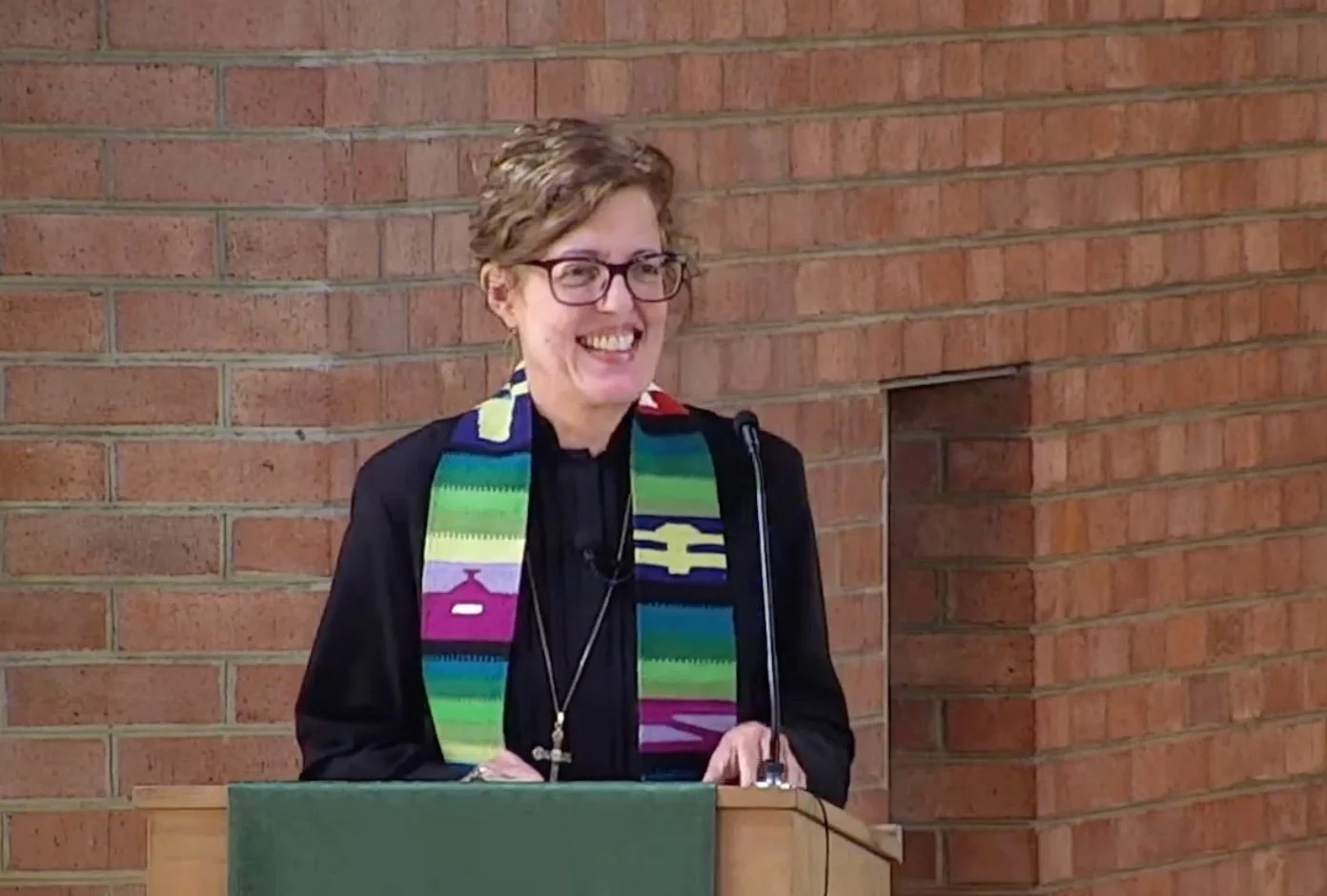
Sermon preached by Rev. Stacy Rector on Sunday, July 19, 2026
Good morning. It's so good to be here with you. I'm so grateful for Pastor Margie and Wesley's invitation and your warm welcome. I see some familiar faces and new faces, and I hope I get a chance to speak to everybody when the service is over.
A little bit about my background: everybody knows when I preach you often hear about my grandmothers. I was very close to them and grew up with them right around the corner. So I've got a lot of good stories about grandmothers. But the church that raised me was a rural Cumberland Presbyterian church in West Tennessee, where the 20 or 30 folks who regularly attended were all related to each other either by blood or by marriage—I was never sure. And for most of my life, I was the sole Sunday school member of my grandmother's Sunday school class. Needless to say, I aced my Bible content exam in seminary because of my grandmother.
She was the unofficial pastor of the church. She wasn't ordained. She didn't have a college degree, but when things needed to get done, Mama did them. She taught me Sunday school, as I said. She also played piano for the church services. She ran the Cumberland Presbyterian women. She visited the sick and those in the nursing home, made sure all the special offerings were taken. And any seminary student that made the drive from Memphis for the occasional preaching at our little country church always got fed.
And though she was probably one of the most loving and faithful people that has ever walked this earth, she had her church lady side—if you know what I'm talking about. You know what I'm talking about. With just a look, she could let you know that she was not pleased. And she was not afraid to speak her mind or drop the occasional guilt bomb. One church member who grew up under my grandmother's tutelage was not the most consistent churchgoer as an adult. And after my grandmother's death, as many whose lives she touched were sharing stories about her, he said, "You know, if I missed a few Sundays and ran into Miss Dorothy at the grocery store, she didn't have to say a word to me. I'd just start confessing I'd skipped church to go fishing."
Now, my hunch is Jesus was likely a faithful attender of synagogue services, so perhaps would not have gotten any of those looks from my grandmother, but he does seem to have an affinity for fishing. So, I don't know. John's gospel reports that one of the first things Jesus does after his resurrection is appear to his disciples, instructing them on how to catch a few more fish. And of course, one of his most famous miracles includes a fish fry. Perhaps then it is no surprise that these fishermen recognize a kindred spirit when he calls to them.
Now, the gospel doesn't give us many details, if any really, about why these fishermen on the spot were told immediately join Jesus. But it doesn't seem to take much for Peter, Andrew, James, and John to drop their nets, to drop their livelihoods, their families, even, to follow this one who calls them now to fish for people.
On the other hand, in our other text for today, minus a few verses, we meet Jonah, who is not ready to drop anything to get with God's program. And if you remember the story from Sunday school, in a futile attempt to flee the line that God has cast, Jonah ends up serving as bait.
These texts remind us once again, as we need to be reminded over and over, that God chooses to reveal God's power, God's purposes, God's call, not just through miracles and on mountaintops, but through the mundane and the muddled. And as our texts describe, God's call is often disruptive. It throws us off balance. It puts kinks in our plans, because God's way of being, the way of Jesus, is not a particularly easy way, right? We know that. It's rarely convenient or comfortable. It's rarely safe or secure and often doesn't even seem particularly fair. Which leads us back to Jonah and those pesky Ninevites.
I'll give you a quick refresher, if any of you need it, on Jonah's story. God calls him, tells him to go to Nineveh, cry out against the wickedness of the Ninevites. They have a pretty awful reputation for being a bunch of mean people. And though it may be downright dangerous for Jonah to go to Nineveh preaching repentance to these immoral people, as we know, such messengers don't often fare well. Fear is not seemed to be what motivates Jonah's resistance to the call. In a moment of honesty that we don't hear in our reading, the text tells us that Jonah confesses the real reason he does not want to go to Nineveh is because the people there don't deserve to hear a word from God. Jonah says, "This is why I fled in the beginning, God, for I knew you were a gracious God, merciful, slow to anger, abounding in steadfast love, and ready to relent from punishing."
Jonah thinks the people of Nineveh might actually listen to him. Maybe they'll change, and God will spare them in the end. For Jonah, this will not do. Utter destruction is too good for them. And so the story goes. Jonah flees from God's call, hops a boat. God sends a storm. Jonah convinces the crew to toss him overboard to calm the sea. And God sends a giant fish to swallow Jonah. He remains in the belly of the beast for three days before the fish can't take it anymore and throws him up.
After all of this, you would think Jonah would immediately get that one-way ticket to Nineveh. But no, God has to call him a second time. This time, Jonah does go and tells the Ninevites, "Forty days more and Nineveh shall be overthrown." And by the way, I can't wait. But Jonah's worst fears are realized. The people of Nineveh pay attention to him. They listen. They proclaim a fast. They put on sackcloth. They don't have to be convinced or told a second time like some people. They hear the word of God and repent on the spot. Then we're told God changes God's mind about their destruction. And poor Jonah, he can't take it. He stomps away, sits under a bush, and prays for death, rather than to have to live with a bunch of low-down, no-good Ninevites as his new family. Pitiful.
Now, Jonah makes the disciples in our text look pretty good in comparison. Ironic, since often in Mark's gospel they end up looking confused and bumbling. But here, I'll give them their due. When Jesus calls them to drop their nets and follow, they listen. But we know that won't always be the case, will it? They're the same guys who will argue about who's the greatest. When Jesus most desperately needs their support before his arrest, they will fall asleep on him. One of them will betray him. One of them will deny him. All of them will scatter when he is executed, leaving only the women followers at the cross. And no, in this particular instance, they show Jonah up. They're just as flawed as he is.
But that's the point, isn't it? God's freedom to choose whomever God wants, to call whomever God wants, even the most bumbling, stubborn, and mean among us. That is what God's beloved community is. That's what it looks like. Like Rudolph the Red-Nosed Reindeer's Island of the Misfit Toys. And it can be hard to take sometimes, when we realize just who our sisters and brothers really are, when we realize God loves them just as much as God loves us and that God's not taking inventory or checking off boxes or keeping score. It can be hard to take, even though it's the best news our world has ever received: that our God does not love us as much as we deserve, but as much as we need.
The Ninevites, that mean old bunch of people, they listen to God's call. They recognize their own need for change, and so did the disciples, or they wouldn't have dropped everything to join Jesus. And this is our work as disciples of Jesus too. To listen, to recognize our own need for newness, our own need for change, not just one time, but over and over and over. And not only for ourselves, but we are to encourage and provide support for such newness for everyone. For everyone, even and especially those who challenge us, who push our buttons, who turn our stomachs, or who frankly don't seem capable of change at all.
Our path as disciples of Jesus is not the path of least resistance: staying where we are as we are, clinging to what we have, to those we know, and not stepping out in faith because of our fear. Our fear that following the call of God in our lives will cost too much. The Ninevites could have made that choice, the disciples too. But imagine the life they would have missed out on if they had. Not much of a life at all, really. Certainly not the abundant life that our God longs for each of us to have.
So when God calls, particularly to the hard things, to love the hard people, I mean, Jesus says, follow me. Do we dare? And if so, how? How? When the problems are so big, the people are so broken, the systems are so corrupt, the divisions are so great, how do we follow? Well, I'm not entirely sure, but I think we're off to a decent start here together. Gathering as a body, worshiping, praying, singing, sharing a meal at the table, and then doing what the Ninevites do and what the disciples do, and what's really hard for us to do sometimes: listen. Listen wherever we find ourselves—in our homes, our schools, our workplaces, our churches—to listen to one another with compassion and open to the possibility that we will be changed.
And not only that, we step out beyond our usual spaces and we follow Jesus into proximity to those whose voices have too often not been listened to, or whose voices have been discounted or ignored. Our Black and brown sisters and brothers, the immigrant and refugee community, the indigent, the prisoner, the condemned, the outcast. We must go to them and let them teach us too. Of course, this is not easy. It is not an easy way. We know that. But it is the only way to continue to become who we truly are, the body of Christ, in a world that is hungry for newness, for life.
And if we're reluctant to follow this call to step up and step out, you know what? That's okay. We do it together, with the confidence and the faith that the one we follow, the one we follow, has never asked us to go anywhere that he hasn't already been and will not go with us still. Thanks be to God. Amen.