

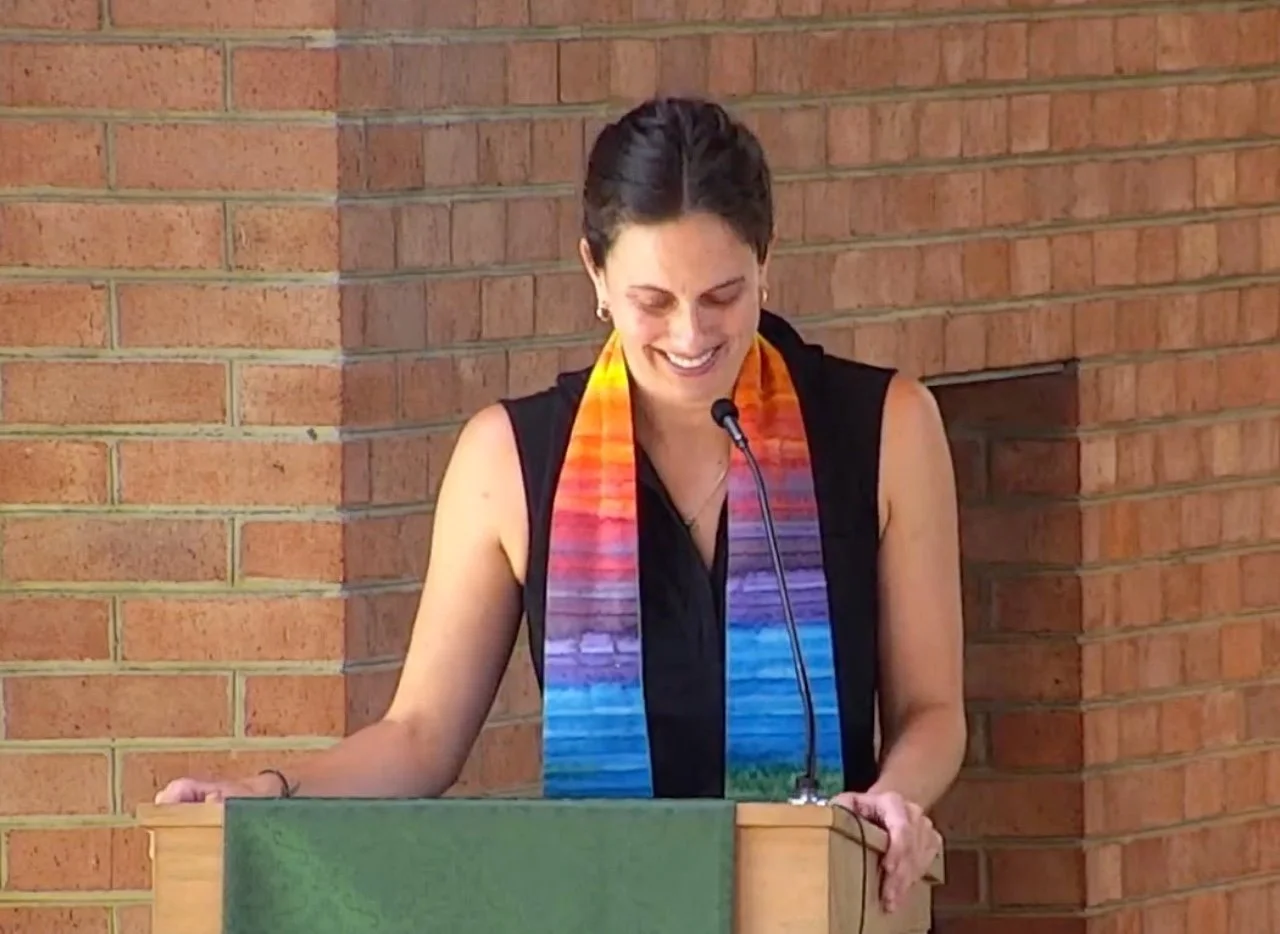
Sermon preached by Rev. Margie Quinn on Sunday, August 9, 2026
Many of you know that a couple weeks ago I went to Iona Abbey, which is on an island off the coast of Scotland. It's an island that's three miles long and one mile wide. Before I left, I went on a walk with my spiritual director. And for those of you who don't know what that is, a spiritual director is a therapist for pastors. So you'll be glad I have one. And after talking to Jean for a while, she looked at me and said, "You are so hard on yourself. Why are you so hard on yourself?" And then she asked me, "Is that how God talks to you?" And I said, "I don't know. I haven't been listening." Well, then Iona is probably coming at the right time, she said, because it's time to listen.
The same thing was true 10 years ago when I was in seminary. The world felt noisy. The political landscape of 2016 was noisy. Studying theology and philosophy and divinity makes the mind a little bit noisy. Screen time and scrolling and all that good stuff was noisy. And on top of that, within my own family, divorce was making things noisy. So I got an email about going to an abbey spring break of that year. I don't know what it is with me and abbeys. It's like the monks. I don't know. So I said yes without realizing in the email that this week at the abbey was a silent retreat. Why are y'all laughing?
I went up to this Cistercian Abbey in Berryville, Virginia, and for a week I was silent. I sent an email to my family that week and I said, "What a gift silence is." But it's also, as it turns out, much louder than I thought it would be. By that, I mean it makes the things that I've been stifling come to the forefront in an almost aggressive manner. Maybe that's why all the other retreaters look pained, too. The only time that we broke our silence in that week was to worship at night with the monks to do an evening service where we chanted the psalms and read the liturgy. And on my last night there, for whatever reason, one of the monks approaches me and says, "What are you doing here? What are you doing here?" It's the same question that God asks Elijah today. What are you doing here, Elijah?
If Jeremiah is the weeping prophet and Jonah is the reluctant prophet, I think Elijah is the fleeing prophet. And for good reason. He has just killed about 400 false prophets that were worshiping Baal. Not the Israel's God of love and liberation and care for all people, but a different kind of idol. And Queen Jezebel, the head of all of these false prophets, wants to kill him. We keep having these stories where someone wants to kill someone. She wants to kill him. So he's on the run. And in First Kings 18, it says Elijah was terrified. He got up and ran for his life. And we're not talking about a couple miles. We're not talking about a couple days. We're talking about three weeks of running over rough terrain, not knowing if he was safe or not, trying to get away and run for his life. At one point, he even asks God, "I don't want to live anymore. Take my life. I'm scared." But God is a God of provision and continues to feed and nourish Elijah as he's on the run.
Elijah's walking an ancient path. It's actually one that Moses has walked before. Elijah makes it to Mount Horeb, which is the same mountain that Moses received the Ten Commandments. Elijah traveled 40 days and 40 nights after hiding in a cave. But unlike Moses, who stood up to Pharaoh, who had the courage and the boldness even with a stutter, Elijah cowers to Queen Jezebel and doesn't trust in a God who has promised to always be with him. And so God asks him, "What are you doing here, Elijah?" Elijah says, "I have been very zealous for the Lord." Zealous here means to campaign or to champion. I have been championing you, God, the God of hosts. For the people of Israel, they have forsaken your covenant. They have thrown down your altars and killed your prophets. I alone am the only one left, and they want to kill me, too.
Go out, God said, and stand on the mountain, for the Lord is about to pass by.
Now there was a great wind so strong that it was splitting mountains and breaking rocks, but God was not in the wind. And after the wind, an earthquake. But God was not in the earthquake. And after the earthquake, a fire. But God was not in the fire. And after the fire, the sound of sheer silence.
The Common English Bible version of that is a sound, thin, quiet. The King James version, a still small voice.
And when Elijah hears it, he wraps his face in his mantle and he goes and he stands out at the entrance of this cave and a voice says, "What are you doing here, Elijah?"
And he says the same thing. I have been very zealous for you. I've been campaigning for you. They want to kill me.
A few things here for those of you who find that God does show up in the noise. That is true of God in the Hebrew Bible. Earthquakes and winds and fires, God has shown up there. But today, to this fleeing prophet, God makes herself known in the silence.
What comes up for Elijah in that moment? I have a feeling it's things that he doesn't want to confront. And what comes up for Peter and the disciples when Jesus stills the wind? Because did you notice that it's not when Jesus walks on water that they say that is the son of the Lord? It's when Jesus quiets the wind that they are able to proclaim truly you are the son of God. As if in the silence they experience feeling known and seen and heard by God.
Sometimes it takes stillness for us to feel the Lord passing by.
There is this place in the Hoh Rainforest, I've talked about it before, in Olympic National Park in Washington State. It's called one square inch of silence and it's marked by a red stone and it is placed on top of a moss-covered log and it is said to be the quietest place in our country.
There are only 15 places left in our country where you can experience 15 minutes or longer without any noise intrusion. 15 places.
We are starved for silence and yet it is becoming dangerous. Silence. When we listen to ourselves, when we listen to a divine, still small voice is being co-opted by productivity and efficiency and noise. They don't want us to hear from a God that makes himself known to us when we quiet down.
It may seem like you have to go overseas or up to Berryville, Virginia to find silence, but you don't. You don't. The location of Elijah's encounter with God, it actually doesn't matter. Yes, it's significant because that's where Moses stood, but many commentaries said he could have experienced God anywhere. In the cave, in the wilderness, in the temples, which means that we don't have to go anywhere to feel the Lord passing by.
I was in an old Bible study once and we talked about this passage and we made an agreement. Okay, at 3:03 p.m. every day, we're going to set a timer. And for that moment, wherever we are, we will pause. We will look around. We will listen. For months we did that, checking back in weekly to see what had come up, what had been noticed, what had been heard.
Because believe it or not, lots of things come up in silence that we don't want to face. Oftentimes when I get quiet, it's the things that I'd rather avoid that speak to me. You are lonely. You are scared. You have lost hope. You are tired. You are frightened. You miss him. You grieve her. You don't want to be alone.
And then oftentimes underneath the scary stuff is a loving voice. One of mercy and grace, always ushering me back to believe that I am beloved. God is well pleased with me. But if we don't take time to listen, how can we ever hear the still small voice of God? And if we don't take time to listen to God, how do we think we're going to be able to hear each other in a world that really doesn't want us to listen to each other? Amen.
There is an American composer John Cage. He wrote a song called 4'33". Do you know this song? Of course TJ knows this song. There are no intentional music notes. There's a video of him sitting at the piano and setting his timer, and for 273 seconds.
Perhaps that's the only time in the audience's day when they hear nothing and therefore hear everything, or the only time in their week or their month.
Elijah's response before and after this event. This is what's kind of frustrating and kind of interesting and a lot relatable is that did you notice before this moment of thin quiet, God asks, Elijah, what are you doing here? And Elijah answers, I'm scared. I'm scared for my life. I'm running away. I have been campaigning for you. Why aren't you here for me? And God gets Elijah's attention in ways that God has been known before. And then silence. And then again, God asks, perhaps hoping that Elijah was transformed by that 4 minutes and 33 seconds. God asks again, "Elijah, what are you doing here?" I'm scared. I'm running for my life. I've been campaigning for you and they want to kill me. And we know that even after Jesus calms the wind that Peter still has moments of doubt and denial.
The invitation there, I think, is that this isn't a one-time show. This isn't a one-time experience. This is a spiritual practice that we have to build up and attempt because it is subversive. Because the world doesn't want us to.
What's also interesting about this story is it's actually a retirement plan. After God says, "What are you doing here?" for the second time, and Elijah answers in fear, God says, "Okay, go back down the mountain. I'm decommissioning you and I'm going to appoint Elisha, a new prophet."
Perhaps in that moment, God saw Elijah's fear and thought, "Then I will give you a rest." Perhaps in that 4 minutes and 33 seconds, God felt Elijah's fatigue when Elijah was able to say perhaps the most raw, honest things to God in that stillness that he wasn't allowed to say in the noise.
God wants to pass by. God is passing by. God is calming the wind and inviting us day in and day out to take a moment, a moment for something beyond and greater than us to speak.
When I got to that island, when I walked around Iona, I felt flooded, flooded with mercy. And I heard God say, "It is enough. To have helped one person, it would have been enough. You are enough."
Thank God that in that moment and in moments that we can find if we look for them, we hear a still small voice.