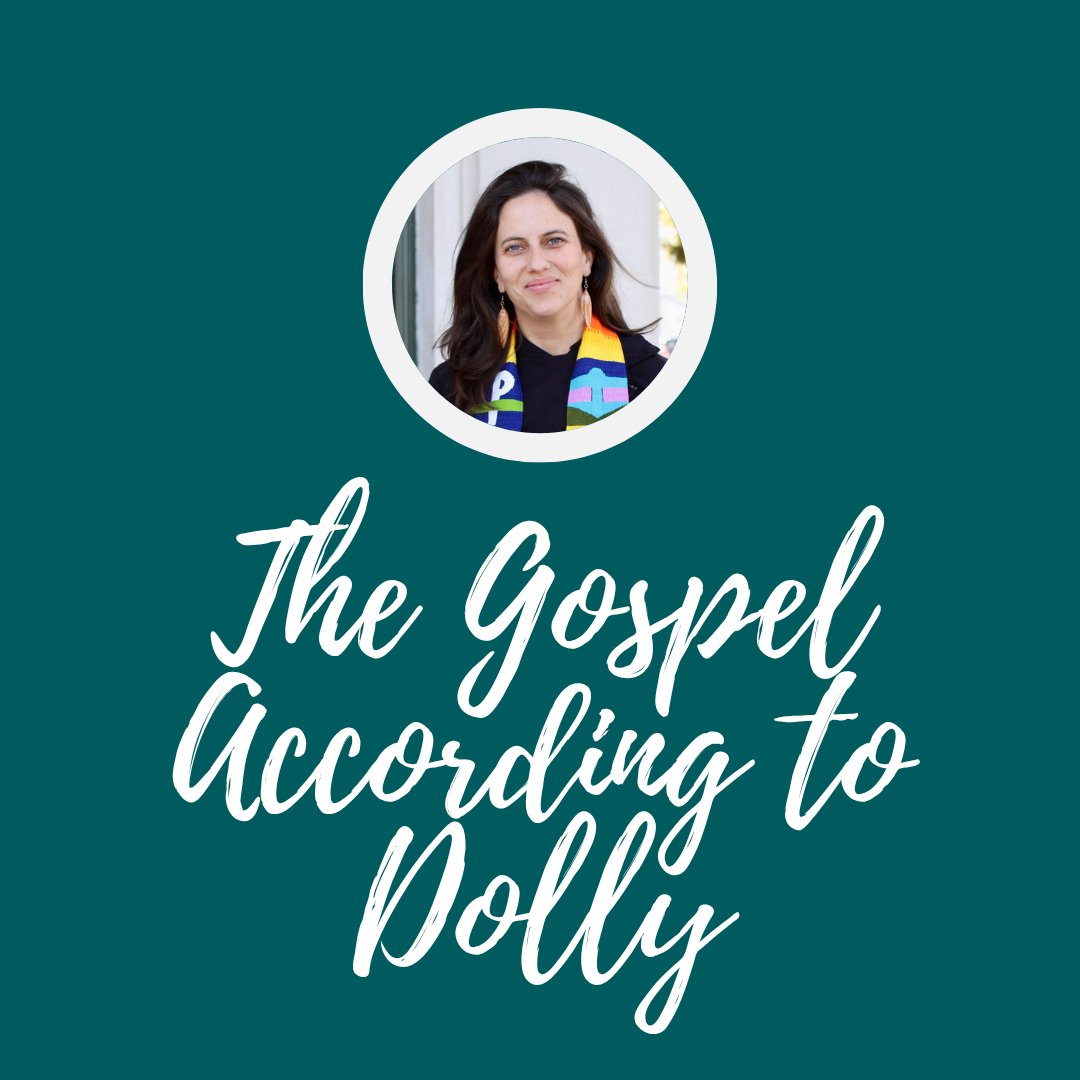

Sermon preached by Rev. Margie Quinn on Sunday, August 30, 2026
We've been through it this week, haven't we, Nashville? And I reckon I'm going to preach about the Bible, but I'm going to preach about Dolly Parton, too. Is that okay with y'all? We've been through it this month in the Gospel of Matthew. In the beginning of this month, Jesus walked on water and stilled a storm. And then he had his heart and his mind transformed by a Canaanite woman, an unlikely soul who didn't back down, who begged for her blessing until her daughter was healed. And then he went on a few more healing tours. He saved a few thousands with food. He made Peter the very rock on which he would build his church. "You are the Messiah," Peter told him. "You're the son of the living God." Jesus handed him the keys to the kingdom. And then today, just as the disciples were hearing about this Messiah who brought good news, they get some bad news. I am going to Jerusalem. Jesus told his crew to suffer, not only to suffer, but to suffer at the hands of the elders, at the chief priests, at the scribes, and I'm going to be killed. As Caroline Lewis writes, this is what we call a passion prediction. He knows what's coming. We know what's coming. He's trying to prepare them for it. And Peter, the guy jingling the keys of faithfulness and trust, takes Jesus aside in what must have been pretty unimaginable pain. And Peter rebukes who he just called the Messiah. "God forbid it," Peter says. "This must not happen to you." And Jesus replies, "Get behind me, Satan." Professor Eugene Gibson points out that it's not that Jesus sees Peter with pointy horns and a tail, but rather Peter is in this moment an adversary of God's will. Peter, who has been jingling the keys, has forgotten that they are attached to his belt loop. That his confession of faith has made him the rock. And in this moment, the rock becomes the stumbling block. A saint to a sinner. Can anybody relate to that? How quickly we can change our minds and turn our hearts rather than remembering divine things like the one who is the creator and redeemer and sustainer and comforter, the God who is with us. So then Jesus looks around at his guys and he says this. If you want to follow me, you're going to have to carry a cross. And it's going to be heavy. You're going to have to carry it. Even as you stumble after me, tripping over your shoelaces. And if you want to save your life, you've got to lose it. But if you lose your life for my sake, guess what? You find it.
And this moment, as Jesus gives them yet another stern talking to, I hear in his voice a challenge. I reckon Jesus is telling them about outlaw Christianity. Will you say outlaw Christianity? I read about outlaw Christianity this week as I looked into the life of our Tennessee saint, our honky tonk angel, our Appalachian Jesus, as one article wrote. This piece in the New Yorker called Dolly Parton's Christianity outlaw Christianity. I think she might be one of the best examples of taking up a cross and following Jesus, our outlaw.
For those of you who don't know, her roots are really interesting. She grew up in, as Casey Kemp wrote, a sharecropper's cabin in a Smoky Mountain holler. Like a secret siloed missile built from blonde hair, hope, mascara, and the King James Bible. She grew up with 11 siblings in a one room log cabin just a few hours from us in a family of poverty, and is the granddaughter of a Pentecostal preacher. Who's the grandkid of a preacher? No, you are. Who else? Yeah. She was raised in struggle, but she was never embarrassed about it. Kind of reminds me of another guy born poor, raised in struggle, unashamed of his roots, who was focused on the kind of mission brought to the poor. She didn't like the kind of gospel her granddaddy was preaching. She said, "Hell, fire and brimstone." Anybody grew up with a gospel like that? So, she started sneaking away to this abandoned church on a hill where teenagers went to drink at night with broken windows. And there she felt the presence of God. Not as a chastising, bombastic bully, she said, but as a friend that she could talk to on a one-on-one basis. He is our father after all, she said. Y'all know anybody who went to temples and left some of them because they didn't hear a message of love and then snuck up to mountains to pray and feel a divine presence? Y'all know who I'm talking about. And from then on, she practiced this outlaw Christianity. Here's a definition that Casey Kemp gave. A kind of Christian for whom you can positively see the dust rising from the line that Christ would have drawn in the sand for her, daring the rest of us to cast stones. Y'all know about this outlaw Christian. She didn't shove her religion in anyone's face. And she said she didn't just practice her faith, she lived it. She didn't want to be worshiped. She said because that wasn't biblical. She knew she didn't want to be an idol. She just wanted to live like Christ, to lose her life for the sake of Jesus and in doing so to save her soul. And she lost a lot when she took up that cross. She lost a lot of money. She could have been a billionaire, but she decided to be an outlaw, starting the Imagination Library in which she mailed free books monthly to children and newborns. I'm not talking about a couple million books. I'm talking about over 300 million books have been mailed to people who don't necessarily have access to public libraries or resources to buy them. By 2024, one in seven American children under the age of five had received a book through the Imagination Library. Loaves and Fishes. Reminds me of somebody I know who said, "Let the children come to me for they will receive the kingdom of heaven. It actually belongs to the kids." Y'all know about that man. Could have been a billionaire, could have hoarded her wealth, could have hoarded her fame, her power, and her name. She didn't. She gave Vanderbilt University a million dollars during COVID to fund a vaccine. She created funds when the wildfires came through her county in Tennessee. She lowered the dropout rate in our state, 35% to 6%, giving $500 to anybody who completed seventh and eighth grade in certain counties. Y'all mind if I keep going? Our outlaw who said, "Of course, black lives matter. You think our white butts are the only ones that matter?" No. And I'm replacing the word butt with. Our outlaw who said, "I know trans people and I love them all. I don't judge. I see how brokenhearted they can get over certain things. I know how real they are. I know how important gender affirming care is to them. That's who they are. We are all God's children and how we are is who we are." The words of our country queen, our outlaw. She performed in Queens in 2016. That was a year of a lot of political upheaval and tension to a crowd. Listen to who this crowd was. Drag queens, evangelical Christians, hipsters, people whose lives otherwise would have never overlapped, all waiting to see the same woman. Y'all know somebody like that? A man who ate with and healed and traveled with and loved people whose lives didn't really overlap, did they? Collecting taxes and smelling like fish. And when Whitney Houston's iconic recording of "I Will Always Love You," a song that Dolly wrote in 1973, when that became a smash hit and Dolly started collecting royalties from that song, she gave all that money to a black neighborhood in Nashville. She bought a commercial complex there and she later jokingly called it the house that Whitney built. That wasn't a charity performed for applause. It acknowledged that a black woman with an extraordinary voice had created an enormous amount of wealth for a white woman who said, "I will empty myself out in order to support and empower and celebrate others." Y'all know somebody who emptied out his privilege to save lives. This outlaw Christian, she woke up at 3:00 a.m. every morning. Raise your hand if you woke up that early today. Sherry. Wow. Sherry, we're going to talk. She said, "I woke up at 3:00 a.m. to thank God for the night and to ask God to bless the day. How can you use me?" She asked every morning. "And what can I do today?" I'm writing that down. How can you use me? And what can I do today? Do y'all know a man who woke up early, who prayed at dawn or dusk? I know that man. She has shown me how to know that man. Can I tell you another story that's funny? She called a Nashville church, and it wasn't ours. I don't know why she didn't call us. I'll take it up with her. She called a Nashville church. She told the senior pastor she wanted him to come to her house for a baby dedication. So this senior pastor and a younger associate went. And when they arrived, she had something a little more than a dedication in mind. She wanted them to baptize her granddaughter. She even brought water from the Jordan River back to Nashville, Tennessee, while she had it shipped. So, she left the living room to go get her goddaughter. And the younger pastor looked at the senior pastor and he said, "What are we going to do?" Cuz this was a theological problem. This church didn't baptize babies. The senior pastor said, "Brother, we are in Dolly Parton's house." And Dolly Parton just went into another room to get her goddaughter and the water she shipped from the Jordan River to baptize her with. So, I tell you what we're going to do when Dolly Parton comes back into this living room. We're going to baptize that baby.
Y'all know an unlikely baptism story in which people were perplexed at who baptized whom in that Jordan River in those same waters. Y'all know about that man.
Y'all may think I'm getting a little off script because I know we're here to talk about the Bible, too. But I think, and I've been thinking all week, that in the heart of this passage is this woman's faith. In the heart of this passage in Matthew in which Jesus talks about carrying crosses and losing lives that don't speak of divine things, I think Dolly's faith is right in here. When I look at who's grieving her death, have y'all noticed who is grieving her death? Not just people who look a lot like most of us, but all kinds of kinds. Cuz when we talk about setting that table wide, we may never get to where she was. Pulling up chairs, bringing up picnic tables from the basement. Everybody was invited to that table. And I sure hope we can get there. Jesus's life. It can seem so daunting to try to emulate his obedience to God, his perfection, the way he loved. And yet here is a real life woman who showed us how to lose our power and our money and our fame and our privilege. She wasn't a people pleaser. She didn't care about popularity. She cared about loving all of humankind because she felt that same love from a divine presence in an abandoned church with broken windows. A life focused on divine things.
The disciples thought Jesus was going to be immortal. And how many of us thought Dolly might live forever?
And Jesus gave them a passion prediction. But he also gave them, did you notice, a resurrection prediction? He said, "I'm gonna be killed. I will suffer under the elders and the chief priests and the scribes. And then three days later, I'm coming back." Hope is coming back.
I went to the Brandi Carlile concert last night. Was anyone there? Sherry at that one. You're just up at 3:00 a.m. Okay. Brandi was a dear friend of Dolly's and she gave such a lovely tribute to her last night. She sang through some songs. She showed images of Dolly, and a lot of Dolly's family was there too. And Brandi said, "I think this is the most well-behaved Americans have been in a long time this week." She said, "Probably because Dolly can now see what all of us are doing." I think people are being a little kinder, a little nicer, a little more considerate of who is at this table and who's not. How do we get them there? I got a call from a buddy who was in Knoxville last night. He was at something called a Nitro Circus show. So, this is where guys ride dirt bikes and they do cool tricks as fire shoots out of thingies.
He said, "This crowd really grieved the loss of Dolly." And I said, "My crowd did too," listening to a gay woman from Washington State. We got Nitro Circus and we got Brandi Carlile. And we are all mourning the loss of an outlaw. A different kind of Christian. A Christian that I hope we could aspire to be like. The one who pointed us not toward what is human, not toward what shields us from the love of God, but what is divine.
What would it look like, church, if we lived a little more like our holy outlaws this week? If in our death we saw these unlikely overlaps of people come together to grieve who we are and who we loved. If we laid down our life for a savior who took up his own cross who asks us to do the same. Even when we trip over those shoelaces as we stumble up that hill toward Calvary. Even when our feet sink below the sea a little bit. Even when we misplace our keys to the kingdom,
we could choose comfort or we could choose commitment. We could choose grandeur and we could choose being known. We could choose money and privilege and sheltered. Away from the vulnerable things that scare us, away from the people that we call those people. But Dolly called herself a Jezebel, unashamed of what that word meant.
So I hope you share stories with me about her and what she meant to you as I share a prayer, a prayer from a song she wrote called "The Seeker." Will you pray with me? I am a seeker, a poor and sinful creature. There is no weaker than I am. I am a seeker and you are a teacher. You are a reacher. So reach down. Reach out and lead me. Guide me and keep me in the shelter of your care each day.
Amen.