

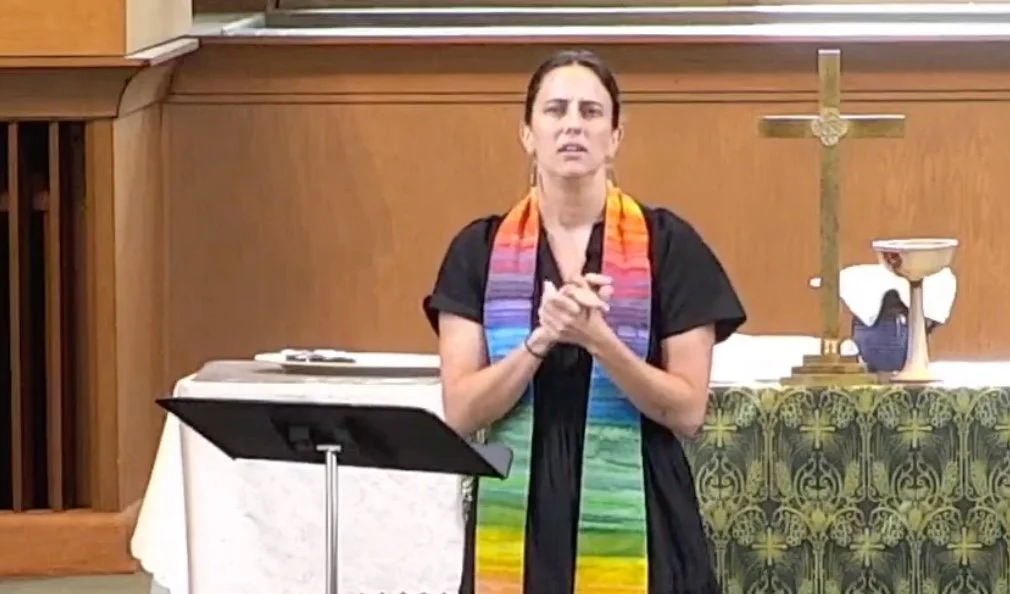
Sermon preached by Rev. Margie Quinn on Sunday, September 20, 2026
The Muppets Christmas Carol. Why are y'all already laughing? You haven't even said anything. The Muppets Christmas Carol is one of my favorite movies. It's one of my family's favorite movies — one of the ones we quote the most in our family. I was reminded of this movie this week by Dr. Barbara Rossing, a scholar on apocalyptic literature in the Bible, who used The Muppets Christmas Carol as a metaphor for the book of Revelation. Y'all know the story: Ebenezer Scrooge, this callous and selfish guy, has lost the meaning of Christmas. His heart has turned colder and colder as his pockets have become fuller and fuller. So he's visited by three ghosts who hope to instill in him a transformation of sorts — the Ghost of Christmas Past, the Ghost of Christmas Present, and finally the Ghost of Christmas Future. The Ghost of Christmas Future takes him to a graveyard, and he finds that people are happy and gleeful that a wretched man has died. He comes to realize that they're celebrating his death. Scrooge looks at the spirit and says, "Are these the shadows of things that will be, or the shadows of things that may be only?" The spirit points at the gravestone, and Scrooge slowly approaches. "These events can be changed," he cries out. "A life can be made right." He clears the snow from the stone and finds his own name. "Please, spirit, no," he says. "Hear me. I'm not the man I was. Why would you show me this if I was past all hope?"
We are in week three of studying the book of Revelation. That word simply means a revealing or an unveiling — not revealing a future escape from the world, as we've come to learn together, but unveiling what already is happening in the world, and what could be if we don't take a good, long look at the brokenness of Rome, or the many names that Rome has had throughout history. For those of you just tuning in, there's a guy named John — not John of the Gospel of John, but John of Patmos. He's exiled on the island of Patmos, and he's writing a letter to seven churches along this Roman postal route — like down Harding and West End and back again. He's writing to churches, some of which are poor, some of which have more resources, but all of which are slipping into spiritual apathy and complacency, and starting to be tempted to worship Roman imperial culture rather than a god who made manifest in a vulnerable lamb. That's the image of Jesus throughout this book. Last week, John addressed these churches, and then he had a vision — a vision of a heavenly throne room. But instead of the emperor being seated on this throne, it was God. And instead of Roman rulers and attendants bowing down before this ruler, it was angels and creatures of every kind and elders. Worship, John seemed to say — heavenly worship. I'm inviting you to consider this: the gathering, the centering, the singing, the listening. This was a different kind of worship. And by the end of it, remember, there were rainbows and seas of glass and singing — not to an emperor that the emperor was worthy, but to God: "Thou art worthy. Thou art the one to receive power and honor and glory. Amen and amen." Feels like Christmas morning.
Wow, what a heavenly sight. And we could just stop there, couldn't we? But then, just like that, the Lamb — let me give you a little visual. Pretend like this is an ancient scroll. The Lamb is holding a scroll with seven seals on it, and the Lamb begins to open the first seal. In a galaxy far, far away — just kidding. The Lamb opens the seal, and here begins the messy middle of the book of Revelation. The messy middle, which is Revelation 6 through about 19. We're not going to get to all of it today — and that's why we're studying it the whole year. Just kidding. This messy middle — it's not a prediction. As Dr. Rossing points out, this is a wake-up call. This messy middle, this seven seals and seven trumpets and seven bowls of wrath, is showing the churches that there is something wrong in the world. There is an illness, and we can't even talk about healing and hope until we've really addressed the diagnosis. We've got to really examine what is going on in the world. And folks, it ain't good.
Just how sick is the Roman Empire? Just how sick is the state of things on earth? We're about to find out.
The first seal opens, and there is a white horse. There's a rider on this horse with a crown and a bow and arrow, and this rider came out conquering and to conquer. The color white at that time meant victory — but not eternal and holy victory through peace, but victory through violence, military conquest. We've got to think about — in that time, just twenty-five years earlier, this invincible Roman legion had been crushed by the Parthians. So this horse, this metaphor, is familiar to these churches reading this letter from John.
The second horse: the horse of war. Its rider was given a sword, and it was permitted to take peace from the earth so that people would slaughter one another. The people would be reminded when they read this that just a few years after this Roman army was thrashed, there was a bloody civil war in Judea, destroying Jerusalem and the temple. They would remember that.
And then a third horse. This horse was black, and a voice said, "A quart of wheat for a day's pay, and three quarts of barley for a day's pay." This horse was famine. And the tragedy of famine, as we know, is that daily necessities — like wheat and barley, or gas for our cars — are priced out of range for average workers. That's what happens when we enter war. So around the time of John's writing, the crops were failing. There was a disruption in the food supplies. This horse would have been familiar.
And finally, a fourth horse. This horse was pale green, ashen, like those who die. Its name was Death, and Hades followed it. Its rider was given authority to kill in all kinds of ways.
These are the first four seals opened in this scroll, and they show not what is going to be — they show what is. They are revealing a sickness and brokenness in this world.
And then there's a fifth seal, because we're not done yet. This fifth seal is opened, and under the altar are the souls of the martyrs — people who have been killed and persecuted for their faith — and they are told to rest, because unfortunately, more people will die. But it won't last forever. This would have been familiar to them. Thirty years earlier there was a great fire in Rome, and Christians were blamed for it. So many suffered and died. This fifth seal, these martyrs under the altar — it would have been familiar to these people.
And a sixth seal — this one is so gripping and haunting and jarring. There's an earthquake. The sky turns dark. There are gales of wind. You've got to remember, Mount Vesuvius had erupted thirty years before, so this image of ash and darkness, of wind, of the earth rumbling — it wouldn't have been unfamiliar to these people. All the kings and the army generals and the rich and the powerful — they want to hide in caves. Why? But not just them — everyone, slave and free, everyone wants to hide. They even say, "Let the mountains fall on us, for we want to hide from the wrath of God."
How bad was it that they thought God was wrathful? When, in fact, as William Barclay points out, the wrath of God is always the wrath of love — which is not out to destroy, but even in anger, is out to save the one it loves. How bad had it gotten, church, that they thought they would be punished? They're so scared, even though they have forgotten our God is not one of wrath but liberation. And so they ask, "Who is able to stand? Who is able to face and endure what is going on?"
And then the seventh seal is broken. And this seal — you'd think it would bring more violence. You'd think it would bring more chaos and pain and bad news. And yet what it brings is thirty minutes of silence in heaven.
As if everybody needed a little nap after all that. Thirty minutes of silence in heaven. Is it the calm before another storm? Or, as a couple of theologians have pointed out, maybe that silence was heaven halting — a listening. Because what happens in chapter 8 is you start to hear the prayers from the saints. Even the music of heaven and even the thunder of Revelation are stilled, so that God's ear may catch the whispered prayer of the humblest of God's trusting people. War and famine, military conquest and disease, cosmic upheaval and the killing of the souls of martyrs, the powerful and the disempowered hiding — and then silence.
And I wish it ended there, but this is the messy middle, and so it's back to the brokenness of the world we go. Angels enter the scene — seven of them. This number seven keeps coming up: Sabbath, wholeness, unity, the churches. Seven angels holding seven trumpets, and later these angels are given seven bowls of wrath. And in both instances, what they sound out and what they pour out are seven plagues. And these plagues are not just random plagues — does anybody want to guess what these plagues are reminiscent of?
Egypt — I heard it. Whoever that was, I've got a cake for you.
The plagues of Egypt. So when we read about these trumpets and these bowls, what's poured out, what's sounded out, are frogs and boils and the water turning to blood and fire coming down. It was the same reminder of these plagues that were begging Pharaoh to repent, and he didn't. As if God is saying something about these nations that also won't repent. As if John, like Moses, is trying to speak to these unrepentant people and say, "Did you not hear when I unsealed the scrolls? Did you not hear the Lamb? Did you not hear the trumpets? Well, then it's time to pour out these plagues."
This is a messy middle — a diagnosis of spiritual and ecological disaster and brokenness, if nothing changes. And if you want to keep reading — if you're a really good student, like whoever said Egypt — what continues is more beasts and dragons, metaphors for Roman imperial rule, for people at that time who demanded power, who were greedy, who were hungry for everyone to worship them, to say, "Thou art worthy." To say, "Thou art God." To say, "Thou art Lord."
This vision didn't happen in a vacuum. This vision happened as a reaction, as a promise that things could be, can be different, if we can wake up enough and shake our spiritual apathy enough to see it. You picking up what I'm putting down? That even though this book feels long ago, it is right now.
And so we ask, just like Ebenezer Scrooge: are these the shadows of things that will be, or are the shadows of things that may be only?
Why would John show us this? Why would John show them this if all hope was lost?
Clearly, not all hope is lost. But in order to have hope — this is kind of the ironic thing about hope — in order to really feel a sense that things could get better, we have to see things as they are. We have to be unflinching and willing to look at the wound. And in this case, the wound is great. If in order to heal, we need to know what we're healing.
John — he's pulling back these curtains. He's showing us different images. Maybe some of you musicians understand the trumpets. Maybe some of you ceramicists understand the bowls. Maybe some of you writers understand the seals. Example after example, image after image, to try to get their attention, and ours.
And what Scrooge says at the end of this movie — and your homework is to go back and watch The Muppets Christmas Carol — it might be exactly what we need to hear today: "I will not shut out the lessons that the spirits have taught me. Tell me that I may sponge away the writing on this stone. Spirit, please speak to me." That's what he says. And so this morning we ask: Spirit, speak to us, that we may not shut out the lessons of a book that can feel intimidating and strange and scary and hurtful, but that we may see a book of lessons that speaks to this moment. That we may see a Lamb on a throne — God flipping the script once again, reminding us that not all hope is lost. Not yet.