
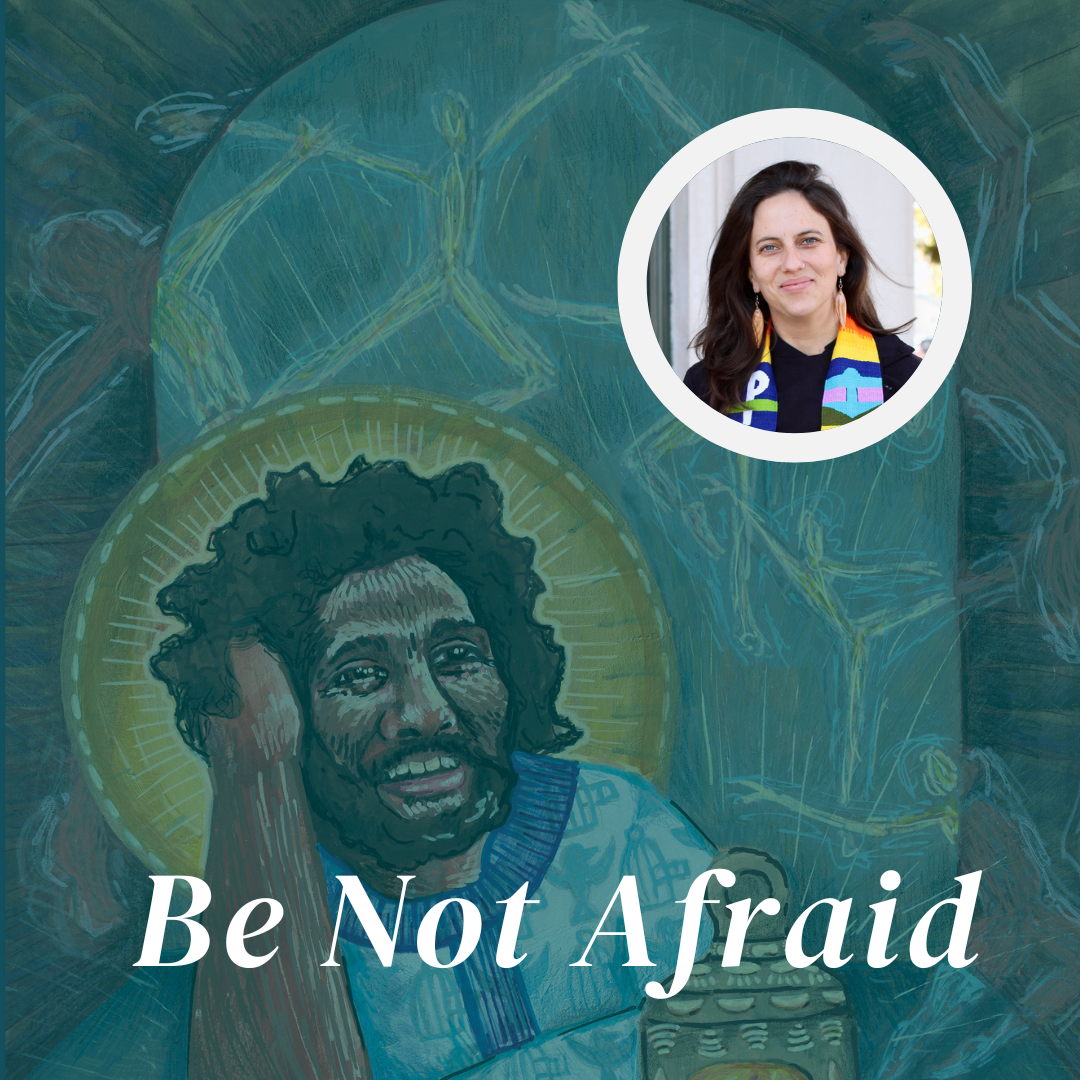
Sermon preached by Rev. Margie Quinn on Sunday, November 30, 2025
Good morning. Happy Advent.
I first want to thank Reverend Dr. Boyung Lee, who is a feminist theologian and professor of practical theology at Iliff School of Theology. She informed a lot of this sermon.
“In the days of King Herod” — that might as well be the beginning and end of our Advent discussion. In the days of King Herod — those six words might as well frame everything that we will talk about on our way to Christmas. In the days of King Herod, a particular time and a particular place, that's when God chose to enter the world. And it was a fearful time.
Have you heard about it, church? I want to tell you about the days of King Herod that were filled with violence and occupation and fear. Filled with a ruler who governed to secure oppression, to maintain economic insecurity. A world where the rich got richer and the poor got poorer. Have you heard of this world?
In the days of King Herod, he governed with paranoia and cruelty. He had a guard of over 2,000 soldiers. He maintained his power by coercion and surveillance. In the time of King Herod, he had many expansion projects that required a lot of funding. Have you heard of this world?
In the time of King Herod, the world was loud with threats, echoing with grief and longing. And this is when our Advent story happens. Jesus didn't come in a vacuum. It wasn't random when God chose to break into this world. It was very much in the midst of these political realities that God sensed that the people were really afraid and broke in amidst that fear.
And it's really important for us to understand this, not only in the story of Jesus, but in our story today—our story of this aging priestly couple named Zechariah and Elizabeth. Because in the time of King Herod, they felt the larger fear of a tyrant’s rule. But they also felt this personal fear, which often shows up as longing: that they were barren and wouldn't be able to have a child.
In the time of King Herod, barrenness was seen as divine judgment. People really thought that if you were barren—unable to have a child—you had done something wrong in the eyes of God. And so what Zechariah and particularly Elizabeth were experiencing was not only personal grief, but public shame.
And still, it says both of them were righteous before God. They lived blamelessly according to all the commandments and the regulations of the Lord. They were doing life right, but they didn't have children, and they were getting older.
How many years had they been waiting to bear a child? How many years had they felt the shame of this barrenness? How many years had they looked at their friends who kept getting pregnant, or their friends running around with their kids, and thought, “When will it be my turn, if it will ever be my turn?” How many years had they followed these regulations of the Lord and lived blamelessly, but maybe stopped believing that the Lord could be righteous to them—going through the motions of faith without actually feeling it? Praying so hard for something they weren’t getting that maybe they stopped praying altogether. With every birthday, with every year of getting older.
How did fear sit in their bodies? How did it live in their hearts?
And still, in the midst of this fear, Zechariah showed up to his life. It says that once he was serving as a priest and it was his time of day. Maybe they cast lots, and he was the one chosen, and he was chosen to enter the sanctuary of the Lord and offer incense. And at that time, all of the people were standing outside of the temple—a great crowd—and they were praying outside, and Zechariah was here, inside, just by himself, burning the incense.
And what happens? An angel of the Lord appears.
And we think of angels as these little white cherubs, little babies—you’ve seen angels portrayed. Scripture tells us they looked terrifying. And I'm going to let you read the Bible to learn more about what they looked like—read the whole Bible; I know you already have. They were really terrifying.
So it should come as no surprise that when this angel appeared to Zechariah, standing at the right side of the altar of incense, it says that when he saw this angel, he was terrified and fear overwhelmed him.
Fear overwhelmed him.
Luke uses the verb tarassō for fear. It’s actually the same verb used when the angel Gabriel comes to Mary—tarassō. The Greek here means to be troubled, disturbed, agitated. It’s not a quick, fleeting feeling of fear, but one that evokes a deep inner shaking—a disruption of the whole body and spirit. It’s the soul’s recoil at the unexpected. It’s the mind’s clamor in the face of uncertainty. It’s the body’s trembling at the threshold of something it cannot control.
That’s tarassō. That’s fear in this text. And that’s what Zechariah felt.
We see again another word used for fear in John’s Gospel. Remember when Jesus says, “Let not your hearts be troubled. Do not be afraid”? That’s a different Greek word there—deilió. (And Lord, don’t check my pronunciation.) Deilió. “Good enough?” “Okay.”
In that context, fear means a shrinking of the heart or spirit—a fear that doesn’t just visit our bodies but settles there. It becomes the background noise of our lives. An unshakable feeling we carry with us, a weariness and overwhelm that no hope can really change. A background noise so constant we forget it’s there.
Maybe Zechariah and Elizabeth knew something about this background noise. Maybe you know something about this background noise too.
And yet the angel said to him, “Drown out all of that noise, Zechariah. Don’t be afraid, for your prayers have been heard. Your wife Elizabeth—she’s going to bear you a son, and you will name him John.”
It is as if the angel is saying: Your fear is real, but it is not the only truth in this story. Your fear is real, but God can still enter into your longings anyway. God can still find where your fear has taken root.
And God can respond—not by minimizing your fear, not by reframing it, not by asking you to repress it, not by ignoring it, not with toxic positivity—but with presence. By saying:
“I’ve heard you.
There’s nothing to be afraid of.
I recognize and honor your fear.
I don’t ignore it.
I don’t deny it.
I know it’s there, and I know it’s real.”
And that happens a lot with our characters of Advent. They are called by God in very unexpected ways. And it’s a God who doesn’t brush aside their fear. It's a fear they show up and express. And it’s a fear they move through.
These characters of Advent are willing to show a particular kind of vulnerability—the kind of vulnerability we see in a newborn baby. They express their fear, and they don’t want it erased. They just want it acknowledged. And I want to repeat that:
They express their fear.
They want it to be acknowledged.
They want someone to hear them.
I think Advent gives us room to sit with our fears and to ask:
What have we stopped praying for?
What are we afraid to even hope for?
Where has fear caused us to shrink back?
How does fear live in us?
In this season of waiting, I don't think God is asking us to reframe it or ignore it. I think God is asking us to face it and name it.
What do you fear, church?
I'll tell you some of the things that I fear:
I fear for this world. I fear what we are doing to it—for the climate extremes, for the way we have treated this land poorly. I fear for its future and ours. I fear for our kids and youth—for the world we have given them, for the amount of work they are being tasked to do for justice and mercy.
And personally, I am afraid that I am behind on the timeline of my life. No kids. No partner. What if I've missed it?
Maybe you are afraid, too.
Maybe you’re afraid of being alone this Christmas for the first time.
Maybe you’re afraid of telling the truth about who you are, for fear of rejection.
Maybe you’re afraid of having that hard conversation with a friend or family member.
Maybe you’re afraid you’ll never get over the grief.
Maybe you’re afraid that the estrangement you feel will last forever.
Maybe you’re afraid someone might reveal you’re an impostor at work.
Maybe you’re afraid your relationship won’t survive this emotional drought.
Maybe you’re afraid you’ll never fall in love again.
Maybe you’re afraid of aging and what it will do to your body.
Maybe you’re afraid of your own mind when you get still.
Maybe you’re afraid that your rights will be taken away—that more laws will be passed that threaten your freedom.
Maybe you’re afraid you aren’t doing enough for the people struggling out there—or struggling in here.
Maybe you’re afraid that addiction will never loosen its grip on you.
Maybe you’re afraid for your siblings in other parts of the world—living in famine, living in fear.
Maybe you’re afraid you’ll fail at work or fail that exam at school and let people down.
Maybe you’re afraid you’ll never lose the weight.
Maybe you’re afraid you’ve let your parents down.
Maybe you’re afraid you’ve let yourself down.
Maybe you’re afraid you’re not enough—even after what we say here time and time again, that Christ has shown you are.
Have I named any of your fears?
What is it you fear, church?
What are the longings that you bring to God?
I think naming them can be healing. I think when we say scary things out loud, it becomes easier to face them—especially when we say them together. Because maybe we hear the whispers of the angels all throughout this Advent story saying:
“I'm not denying your fear.
But I’m telling you there is nothing to fear.
You don’t have to be afraid.”
Somehow the great irony of this Christmas story is that fear can coexist with hope.
And it's not fleeting, flimsy hope.
It’s gritty hope.
It’s resilient hope.
It’s hope that has known grief and sits with it.
It’s hope that has known fear and lives with it.
It’s a hope that understands that Christ came into a fearful world—not as a king threatening power over us, but in the most vulnerable way possible: as a baby. Somehow fearless even then. And shined as a light in the darkness—the darkness that cannot overcome it.
Whether in exile, under the rule of a puppet king, or in the depths of personal pain, we long for God to break in through this fear and bring us hope.
And I think Zechariah and Elizabeth longed for a Messiah, and they longed for a child. And God broke in and reminded them—and reminds us—that good news is louder than fear.
Will you say that with me?
Good news is louder than fear.
It’s hard to believe sometimes. I don’t know, church. Perhaps this Advent the question is not:
How do we rid ourselves of fear?
Maybe it is:
How do we name it—honestly name it—and still believe that God is near?
As the prophet in Lamentations said:
“I called on thy name, Lord,
from the depths of the pit,
and you heard my plea.
I said, ‘Do not close your ear
to my cry for help.’”
And as Kay read, the prophet said:
“You came near when I called on you,
and you said, ‘Do not fear.’”
For my hope is louder.
My hope can handle anything you say,
anything you feel,
anything you share.
And I do not deny your fear—
I acknowledge it,
and I am with you in it.”
And the whisper of an angel to a fearful man and a barren woman:
“You have nothing to fear.”
There is nothing to fear, church.
Amen