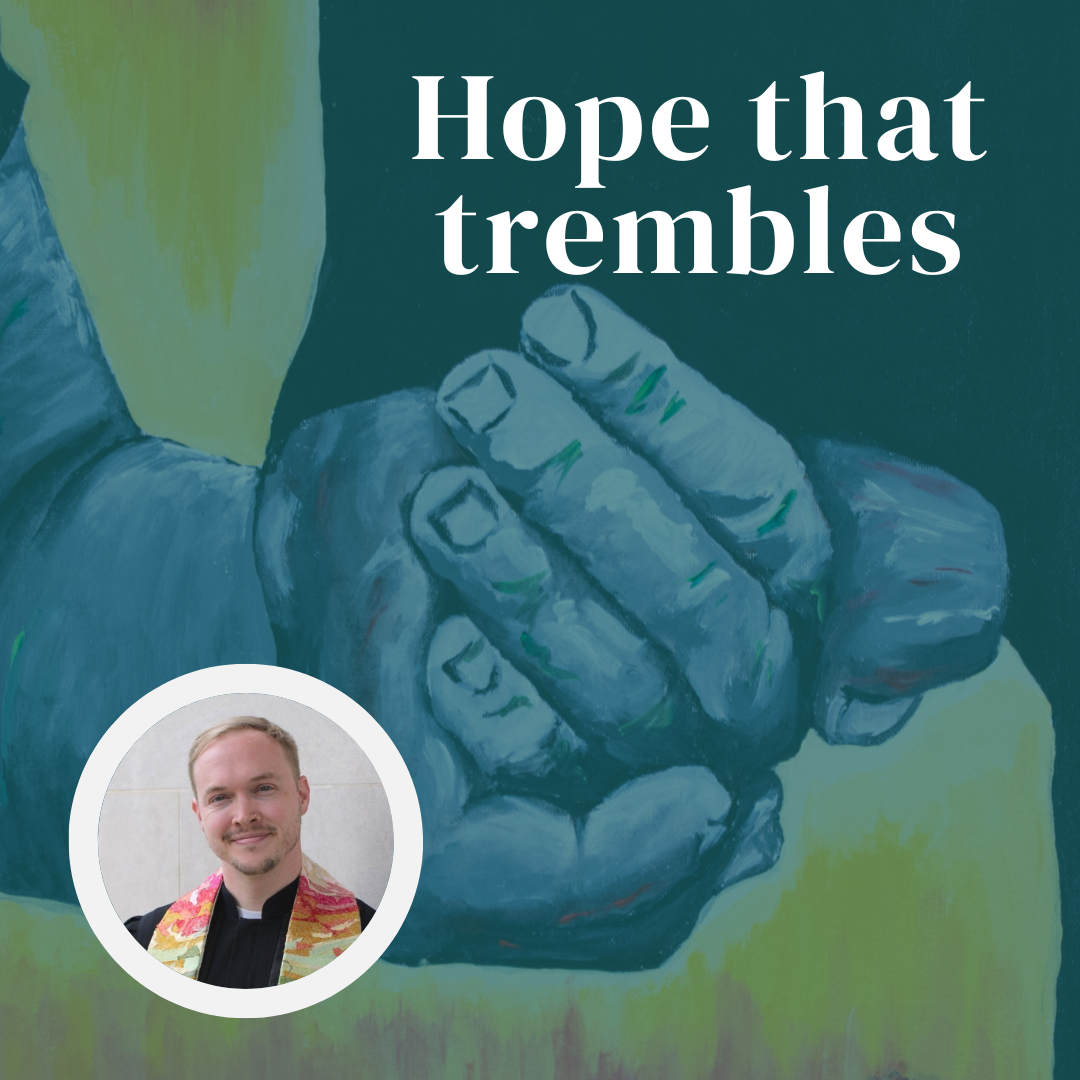
Sermon preached by Rev. Wesley King on Sunday, December 7, 2025
Margie and I had made a wager that whoever won the game got the big office. So, I guess you can stay put. As we begin to dive into the sermon, would you please pray with me this morning?
God, may the words of my mouth and the meditations of all of our hearts be acceptable in your sight. Amen.
Okay, friends, I’ve got to level with you. I’ve got about four more days in my PhD program and then I’m done for the semester. I started back in August, and it has been exciting and invigorating and all the wonderful things, but I am counting down the days. I’ve only got a few more assignments left.
Likewise, I only have a few more days—about six more days—until the Nashville in Harmony holiday show this upcoming weekend at Harkins Hall. Shameless plug. Probably the biggest stressor in my life right now. And so, I’m counting down the days until that is also done. And I’ve got about eight more days of work until I have a nice long vacation until the new year. And so, I’m eagerly counting down the days, as you might be as well.
Now, don’t get me wrong, it has been an amazing year. Starting here at Vine Street in June is top of my list for sure. Margie and I took a wonderful trip to the Florida Keys and to Miami earlier this year. It’s been a wonderful year. And I also lost my Nana earlier this year. And I lost my great-aunt Margene just a few weeks ago. I had ankle surgery back in January that I feel like I’m still recovering from. And like many of you, I’ve watched the news and I’ve watched injustice seemingly prevail week after week and month after month. And so, I’m just feeling really tired. Anybody else feeling tired or worn down, fearful, hopeless?
And in Advent, we’re supposed to be anticipating the birth of the One who is to come, right? But I feel like I could just sleep from now until January 1st. Maybe you’re feeling that as well. That feeling that we’re describing is how we meet John the Baptist in today’s passage. This isn’t the lively, strong, prophetic version of John the Baptist that we first meet in the Gospel readings. This is a John who sounds a bit more like us right now—tired and worn down—an imprisoned John the Baptist. And he’s wondering, “Was all of it worth it? Did I do anything that made a difference?”
Our commentary from Sanctified Art says that he’s a prisoner held under Herod’s authority who is cut off from the movement that he helped ignite. And so he asks Jesus in verse three, as you just heard, “Are you the one who is to come, or should we wait for another?”
And when he asks this question, remember he is in a prison cell. Perhaps he knows that he’s going to be executed. Perhaps he can see his own end in sight. He’s quite literally facing his own mortality. And so he’s wondering if he made the right choice. Did I follow the right man? Are you the one who is to come, or should we wait for another? It’s not just a question. It’s a cry from the edge of despair, our commentary says.
And so he says, “Tell me it was worth it. Tell me that it wasn’t all for nothing. Tell me something.”
This week’s theme is: when we’re running out of hope, God is at work. When we’re running out of hope, God is at work. That’s what we feel in the Hebrew passage from this morning. To a downtrodden, once-enslaved, once and then again-occupied people—a nomadic people and exiled people and oppressed people who were running out of hope—God tells them, “Behold, I am about to do a new thing. Even now it springs forth. Are you paying attention?” God says.
And so I’ve been wondering perhaps this passage in Isaiah and this passage in Matthew is also reminding us that when things seem bleak, when we feel like hope is lost, when we feel like injustice has won, we must remember that we are only seeing a glimpse of the larger picture—a glimpse of the larger narrative that is at work here.
Here’s an example I want to share. Earlier this year, I was down at the Capitol a decent amount, which was hard to do when you’re in crutches in a boot, by the way. And there was this specific piece of legislation that we were there to protest. And this specific piece of legislation would bar children whose parents were here undocumented from receiving a public school education, or they would charge them for it—one or the other. And the idea was that their parents were here without documentation, and so these children were not entitled to a Tennessee education because they didn’t pay taxes, which is untrue.
By the way, undocumented immigrants—I looked this up—undocumented immigrants pay an estimated $96.7 billion, that’s with a B, billion in federal, state, and local taxes. About $59.4 billion goes to the federal government. $37.3 billion goes to state and local government. So that’s not true. And that’s just the undocumented immigrants.
But these folks also wanted to challenge the 14th Amendment that certifies birthright citizenship. And the response was powerful. So many people of all types, of all backgrounds, showed up to protest. It was so crowded in those committee rooms and in the hallways for those who couldn’t get into the committee rooms. Pastors led protests in the committee rooms, reciting and kneeling and saying the Lord’s Prayer without stopping in unison to disrupt those proceedings so that they could not advance this harmful bill.
Our legislators—the bill garnered a bipartisan response, Republican and Democrat—responded to say that this is unnecessary, unkind, unfair, and does not reflect the faith that we profess. This does not reflect a God who said to love and welcome the stranger, to do no harm to the immigrant, and to let the little children come unto me.
And thankfully that bill died, but mostly because of red tape. And I was feeling really hopeless. And so I asked one of the advocates from TIRRC—the Tennessee Immigrant and Refugee Rights Coalition. It’s a long acronym. And I asked them, I was like, “What happens if they bring this up next year?” He said, “Then we show up again next year.”
What we saw in this session is just the latest iteration of what they’re always trying to do to us. It doesn’t always take the same form, but it’s always there. I said, “How do you keep going?” He said, “We have to. What other choice do we have but to have hope?”
And that sentence both convicted me and gave me hope. It gave me hope because in the face—the literal face—looking dead in the face of those who would harm them, those who would vote to oppress them, these folks had the courage and the bravery to stand up and not be silenced. But it convicted me, too, because I just jumped in the fight. And some of these folks have been fighting this same fight their entire lives. And here I was already losing a little bit of hope after a couple of weeks. I wasn’t seeing the grander vision. I wasn’t seeing the hope that they had sustaining them and sustaining them from their parents and their grandparents and their ancestors.
Yesterday I noticed that Migra Watch had posted that two people had been detained by ICE. And so I drove over to the ICE facility about five to seven minutes from my house, and there were a couple people out there waiting, just watching. And I said, “Hey, can I just wait with y’all for a minute?” They said, “Yeah.” So I threw on a stole. And I was talking to them—two gentlemen. One grew up in a secular household, didn’t grow up in church. The other one grew up in church, but left. Didn’t really find a lot of hope there.
And I said, “In times like these, where are you finding hope? What are you doing? We’re out here outside. It’s cold. Like, where are you finding hope? I’m preaching about this tomorrow and I need some material.”
And they said, “I find hope here, doing this—knowing that we aren’t alone, knowing that those people know that they’re not in there alone, that we’re waiting out here and we’re fighting for them. Even if it’s just a couple people that show up, that gives me hope.”
John the Baptist’s question to Jesus is one that we’ve all asked ourselves before—after every protest, every election, every vigil, every life decision, every wrong turn, every failure, every mistake: Did I get it wrong? Was any of it worth it?
Our commentary writes that John’s question is not doubt born out of cynicism. It’s the trembling that comes when conviction meets suffering, when the cost of faithfulness is so high but the fruit of our labor has been so low. They write, “It’s what hope sounds like when it’s running thin.”
But how does Jesus respond to John? Not with chastisement. Not with a lecture. He doesn’t say, “John, you should know better.” Instead, he answers with the witness of what is unfolding. Verses four and five, he says, “Go and tell John what you see and hear. The blind receive their sight, the lame walk, lepers are cleansed, the deaf hear, the dead are raised, and the poor have been brought good news.”
As Pastor Margie spoke about two weeks ago on Christ the King Sunday—about what kind of king Jesus would be—he also gives an answer that subverts everyone’s expectations. He doesn’t point to some big celebration or grand victory, but to quiet signs of transformation. We often find excitement in grand victories and celebrations of our time, but not hope. Hope is more often found in those whispers, in those small acts of kindness, in the smiles from strangers, in the little ways that God shows up in our lives and in our world.
Dr. Lee writes, “Hope in the gospel is not grounded in outcomes or visible success. Hope is rooted in perception.” Right? Our Isaiah passage: “I am about to do a new thing. Now, it springs forth. Do you perceive it?” One of my favorite passages in the Hebrew Bible. Hope is rooted in trusting that God is still at work. Even when the system remains unchanged, even when the prophets die behind the bars, hope that trembles is still hope.
And if you know the rest of the story, you know that the empire is still intact and Herod still reigned. And there have been many other Herods throughout history. John was not released from prison, and he did, in fact, get executed. But verse seven says that as they went away, Jesus began to speak to the crowds about John. And Jesus says, “What did you go out into the wilderness to find? A reed shaken by the wind? What did you go out to see? Somebody in soft robes? People in soft robes are in royal palaces. So what did you go see? A prophet? Yes. But more than a prophet.”
Jesus said, “This is the one about whom it is written: I am sending my messenger ahead of you, who will prepare your way before you.” And Jesus says, “Truly, I tell you, among those born of women no one has arisen greater than John the Baptist. Yet the least in the kingdom of heaven is greater than he.”
Jesus doesn’t see John’s crumbling hope as a failure. Instead, he names it as a part of what makes John faithful, what makes John human, what makes John like the rest of us. Hope that trembles is still hope. Even in doubt, John is still a prophet. Even in fear, he is still beloved.
Or maybe we talk about it this way: even when we are tired or at our wit’s end, even when we’re grumpy or moody, even when our patience is really running thin, or even when our cynicism and our apathy are the loudest voice, we are still beloved, and we still have the opportunity to choose hope.
Nelson Mandela said, “May your choices reflect your hopes and not your fears.” Advent does not require us, beloved, to manufacture hope, but it invites us to bring our emptied hope to Jesus and to ask those hard questions and to listen and look again for those signs of God’s nearness in our world. It asks us to believe the prophet Isaiah’s words from God when he says, “Behold, I am doing a new thing, and even now it springs forth. Are you paying attention?”
When we’re running out of hope, maybe it’s the perfect time, actually, to ask, “What do you see? What do you hear? Where do you see God?” and to trust that somewhere, even now, something new is springing forth—because hope that trembles is still hope.
May it be so. Amen.