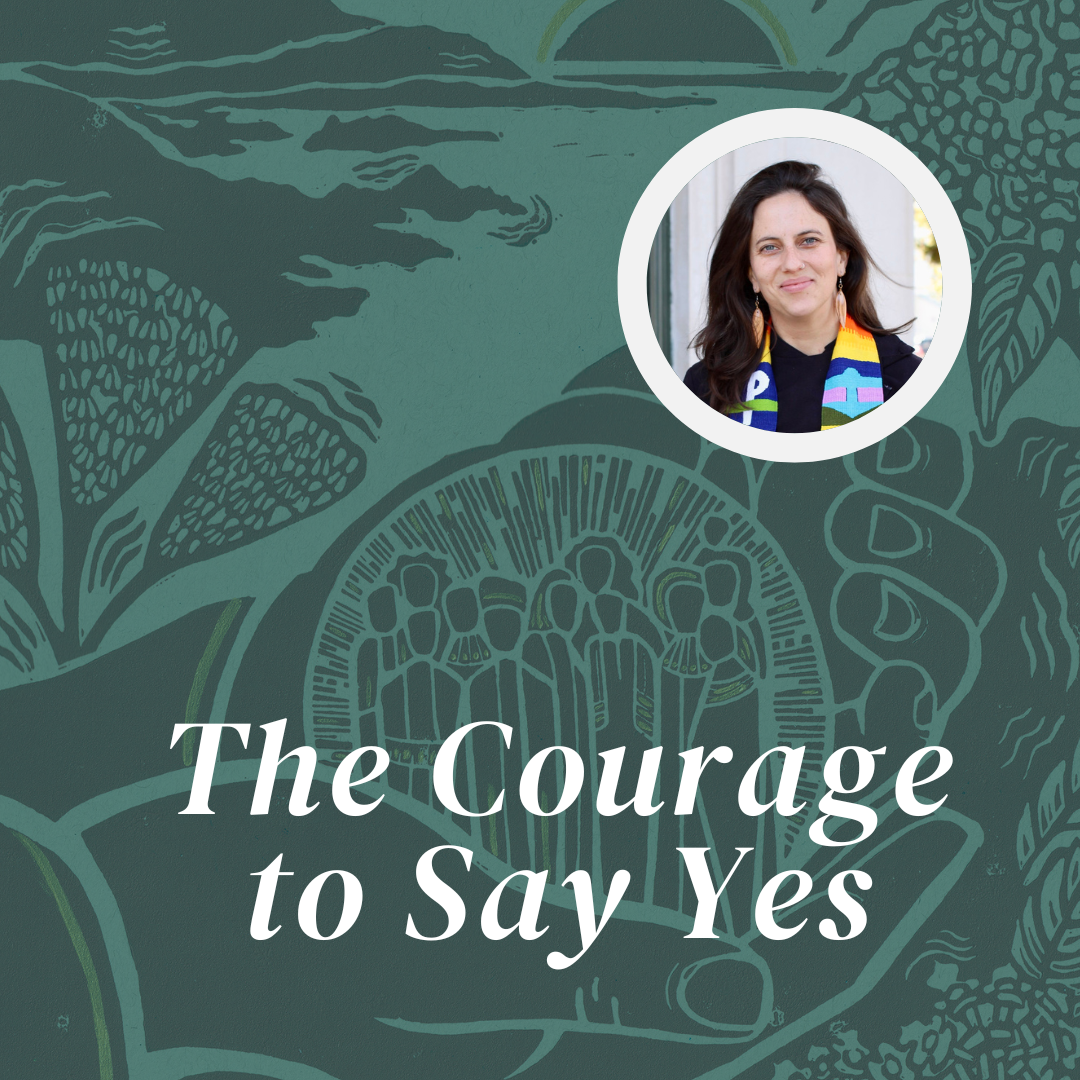
Sermon preached by Rev. Margie Quinn on Sunday, December 14, 2025
There is an event happening today just down the street at Woodmont Christian Church. It’s called Walk Through Bethlehem. How many of you have been to it before? Woodmont is where I grew up and first heard my call. And Walk Through Bethlehem is a live nativity. The church is turned into this ancient town of Bethlehem, with Roman soldiers and live animals—donkeys and even camels some years.
It’s a really coveted position to get to be Mary. And when I was in high school, I got to be Mary. Big deal. And Richie White, who played Joseph, and I—I'll never forget—stood in our full garb, and I was handed a baby doll. We stood out there for many hours, welcoming lines of people as they walked through to see the wise men and the shepherds and the Christ child.
The whole time that I was standing there, I was silent. There was nothing to say other than to just pose with this baby. Actually, the only thing I said that day was when a little kid came up to me and said, “Is that baby real?” And I said, “Baby Jesus was real.” Yeah. Yeah, he sure was. But other than that, I was silent.
I thought about that memory as I heard our scripture today.
We’ve been following this Advent series by insisting on hope in the midst of fear. So, in our first week of Advent, if you’ll remember, we looked at the story of Zechariah and Elizabeth—an old couple living in a time of a lot of fear, under a corrupt ruler, King Herod, who was spreading intimidation, threatening violence, and lording over the people with his toxic power. And yet, even in the midst of their fear, they longed for God to break in. And they showed up anyway. During this fearful time, they were told not to be afraid when they did.
Then, in our second week of Advent, Pastor Wesley preached on this idea that when we’re running out of hope, God is at work. That John the Baptist, when he was sitting in prison wondering if Jesus was actually Jesus, heard Jesus say, “Yeah, I am.” And you aren’t the Savior, but you’re going to point people to the Savior. You’re going to be a voice crying out in the wilderness. When he was running out of hope, God was at work.
And this week, you are invited to consider this: even in our fears, we are called forward. Will you say that with me? Even in our fears, we are called forward.
We hear about two people in our story this morning: the story of Jeremiah and the story of Mary. These are what are called call stories. And notice how I didn’t just ask you to say, “When we get rid of our fears, we are called forward,” or “When we erase our fears, we are called forward.” No.
Our two characters on this day of Advent are a boy and a girl. A boy who says, “I don’t know how to speak, for I’m only a boy,” and a girl who says, “How can this be, since I’m a virgin?”
We often talk about the prophet Jeremiah, maybe placing him at an older age, as a wiser mouthpiece of God. But when his call came to him, he was 17 years old—the same age, around the same age, as Jack or Quinn. He was young. He was a boy from humble beginnings, visited by God, his mouth touched by God to be a prophetic voice in a dark time—a high schooler.
And then I want to talk to you about Mary. This woman that we often depict as shy and wordless, white and porcelain, timid and meek. This was a teenage girl, about the same age as Gia—maybe middle school—living under imperial control, who couldn’t read, who wasn’t married, who was facing a lot of public shame. And so her yes was not an easy one, but one that came with a lot of risk and cost.
What I love about these prophets’ responses—and yes, I think they are both prophets—is that they don’t immediately jump to courage and bravery and quick resolve. Did you notice that? No. They are perplexed. They are resistant. And they are a little bit disturbed by what God is asking them to do.
Two kids, as we might look at them, called to be the mouthpiece of God and the mother of God, called to speak even if their knees shake and their voices tremble.
And in both stories, church, God doesn’t erase their fears. God acknowledges them. I want to say that again. God doesn’t erase their fears. God acknowledges them and calls them forward anyway.
“Do not be afraid,” God tells Jeremiah. “I’m with you. I’ve got your back. I’m not going anywhere.” God gently touches his mouth—the mouth that will speak many words of truth to power, the mouth that will say, “They say peace when there is no peace,” the mouth of justice in a broken world.
And to Mary, the angel says, “Do not be afraid. You have found favor with God, and nothing will be impossible,” even when it seems like it is.
In them—in Mary and Jeremiah—I see not bold bravery, but holy hesitation and timid trust. Have you ever felt that, church? Not bravery or courage, but a timidity in your own lives, in your own call.
Too often, dominant Christianity defines courage through heroic masculinity—like you have to be loud, and you have to be bold, and you have to be certain. But Mary and Jeremiah model a different courage. They model the courage to ask questions, to hesitate, to need more time, and to take just one uncertain step.
What connects them is not a lack of fear, as Dr. Buon Lee writes, “but this deep trembling resolve to move forward anyway.” To move forward anyway—not with certainty, but with open hands and the courage to say yes even in the unknown.
Do you know something about saying yes even in the unknown, church? Especially today—you know those people who like to bungee jump or skydive or do cold plunges in really freezing lakes without any hesitation or sense of fear? I am not one of those people. I hesitate. I whine. I groan. I dip my toe in the water and I scream. I look over the edge of the cliff and I cower in fear. And then I say, “Okay, count me down. Start at five.” And then it gets to one, and I say, “Okay, countdown again. This time start at ten.”
And there are a lot of countdowns before I actually jump. But I usually jump with immense fear—fear that is in the passenger seat of my life, but not the driver’s seat.
There’s a distinction there: that I carry fear with me, that I buckle it up, that it’s along for the ride, but that something holy—something that says nothing is impossible with me, something that says do not fear—is the driver of my life.
Do you know that driver, church? My fear is welcome to be there as I am called into new chapters in this life. But God does not ask me to stay put. God does not invite me to stagnancy. God invites me to hesitantly proclaim, like Mary did, “Okay. Okay. Let it be with me according to your word.”
Saying yes—saying “do your thing, God”—does not mean that the way forward is a cakewalk. And this is the hard part of faith. This is the hard part of being a Christian.
God puts Mary and Jeremiah on a path that comes with a deep cost. Jeremiah, who many called the weeping prophet, was rejected and isolated and alienated for the justice that he so yearned to see in this world. He wasn’t a popular guy, but he was a loyal servant of God.
And Mary—her yes comes at a great cost. One of estrangement and pain. One of loneliness and poverty. And the water is freezing when we take the plunge, and the cost of our yes could be great.
But as we hear in the final verse of this gospel passage today, church, Mary says yes and then runs with haste. Isn’t that such a beautiful way of describing something? She runs with haste to her cousin Elizabeth, reminding us that when we take a step forward in fear, we don’t have to do it alone. We can run with haste to our family and our friends who surround us, who get in the car—maybe in the back seat—who are along for the ride, encouraging us, not erasing our fears, but acknowledging them as we walk into our calling.
And Mary’s next act, after she comes to her cousin and proclaims what she has heard, is not one of shy silence like a young Margie wearing Converse, standing in hay, lips sealed. No. Instead, she sings the longest song of praise that we have in scripture. And I’m not going to sing it—you’re welcome. Maybe you should come sing it.
But what would it have looked like for me, back at Walk Through Bethlehem in my teenage years, to shout these words that Mary says?
God has scattered the proud.
God has brought the powerful down from their thrones.
God has lifted up the lowly.
God has filled the hungry with good things.
God has sent the rich away empty.
That is our prophet Mary, shouting and singing those words. Can you believe her, church?
In this Advent season, I wonder: what fears are you carrying? What invitation are you resisting because you feel inadequate? What fears are keeping you from living into your calling—from speaking truth to power, from auditioning for that role, from trying out for that sports team, from applying for that job, from volunteering for that opportunity at church, from singing that solo, from taking that pottery class, from showing up to that protest?
What fears are keeping you from living into your calling? And what is God inviting you to say yes to—not fearlessly, but faithfully?
Church, in our fears, we are called forward. And you are welcome to protest the fear, just as Mary and Jeremiah did. You’re welcome to wait. You’re welcome to hesitate. You’re welcome to feel a little bit perplexed and confused. You’re welcome to say, “It can’t be me. I’m only a boy.” You’re welcome to say, “How can this be?”
And then you are invited to take one step, and then another.
So say yes with me. Say, “Let it be with me,” even when your knees shake, even when your voice trembles. For the Holy One sits in the driver’s seat and whispers, “Be not afraid,” and says, “There is nothing impossible with me.”
Can you believe it?