

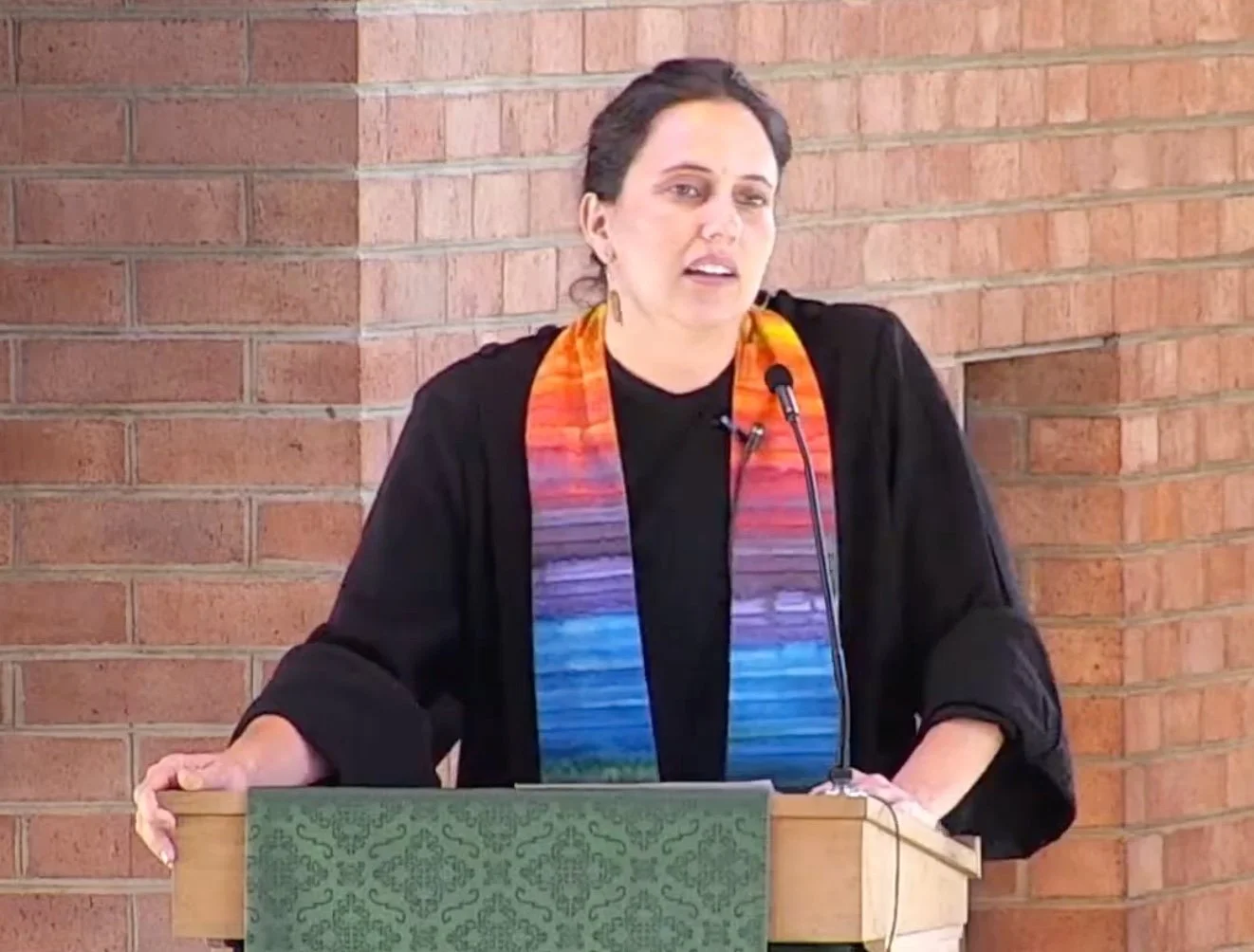
Sermon preached by Rev. Margie Quinn on Sunday, November 22, 2026
About a year ago, I asked my dad to come over and help me with some of the gardening at my house. He brought over the old family pickup truck, and we weeded for a couple hours and threw everything into the back of the truck. He was getting in the truck, hopping up in the passenger seat, and I was saying goodbye to him, and he said, "Oh, one more thing. Would you do my funeral?"
To which I said, "Is there something you need to tell me?" And he said, "No, I've just been thinking about it lately and just wanted to check in and make sure you're cool doing my funeral."
Being a pastor is so weird.
I've been thinking about my dad lately. And there's two ways that his funeral could go. I hope it's not for a while. There's two ways his obituary could go. And the first is this one: My dad was on the honor council at Montgomery Bell Academy. He played football, he ran track and field. He got into Yale University, where he went and ran track and field and was one of the best scholars there. And then he moved home, and he went to Vanderbilt Medical School, and he got his license, and he was a prominent doctor in Nashville, Tennessee, until he retired six years ago. Is anybody rolling their eyes?
That's one way to tell his story. That's one way to brag about him, but I don't find that way particularly interesting. Here's another way to talk about my dad. Every Monday night he's at the state prison meeting with guys on death row. And on Thursday nights he's at Meharry Medical at the Salt Wagon Clinic, training med students to care for the sick, those without health insurance. And right now he is at Alameda Christian Church, one of our Disciples churches in Ashland City, where he's on the community garden team, which provided over thousand pounds of food last year to people in need. My dad is here, there, and everywhere. A couple weeks ago, he slept on one of the cots with the guys at Room in the Inn. Not because he's a member here, but, as he says, he's just a old guy killing time.
My dad makes me a little bit uncomfortable because he is living out Matthew 25 in a way that I am not.
Sometimes the good news, all that he does, is the hard news, all that I don't.
Today in this story, the good news is the hard news. Y'all ready to get a little bit uncomfortable? 'Cause I see y'all. I know it's sweater weather, but I want that sweater to feel a little itchy here in a couple minutes. The first half of this passage, it is comfy. It is good. It is hopeful. It does show God's mercy. The Son of Man comes in all his glory, and not just some nations, but all nations will gather with him. He will separate them into two groups, the sheep and the goats. And he will say, "Come to me, my flock. You have been blessed by God. And here's why. Here's why you will inherit my wild and wonderful kingdom. For I was hungry, and you gave me food. I was thirsty, you gave me something to drink. I was a stranger, and you welcomed me. I was naked, and you clothed me. I was sick, and you took care of me. I was in prison, and you visited me."
"When did we do this?" they asked. "When was it that we saw you a stranger and welcome you? When were you naked and we gave you clothing?" "Just as you did it to the least of these, you did it to me."
That's a faithful flock, is it not? And notice that in that passage, Jesus isn't talking about creeds. He's not talking about orthodoxies and theologies. He's not talking about rote biblical memorization. There's no test. There's no degree or award. No, as John Buchanan points out, the only criteria for this flock is whether or not they saw Jesus in the face of the needy and did something about it.
They gave. They welcomed. They visited. They took good care. And that is good news, is it not, church?
And I wish the passage ended here, and in many churches it does. But Wesley's out today, so not in this church.
'Cause here comes the hard news, the chunk of scripture that we want to turn away from. Jesus looks at the goats, the people who are not showing up, and he condemns them. He says, "Depart from me, for I was hungry and you didn't feed me. I was thirsty and you did not give me something to drink. I was sick and you did not show up to take care of me. I was in prison and you didn't even think about visiting me. I was the stranger coming into Vine Street, the new person at school or at work, and you didn't even say hi."
And they'll say, "Whoa, whoa, whoa, when did we not take care of you?"
"Truly I tell you, just as you did not do to the least of these, you didn't do to me."
This is a chilling text, as one theologian points out. There are some chilling texts in scripture, and this is one of them. And a lot of us, including myself, we're a little bit allergic to texts of judgment. We don't love to talk about sin and judgment when there's mention of eternal punishment and all, but as Professor Matt Skinner points out, this is not an image of the afterlife. This isn't where you're standing at the pearly gates and someone gets to decide whether you go up or you go down.
This is an image of what it looks like to follow Jesus. And the afterlife part, well, that's a part of our everyday faith. It's pushing people to see that in every moment of your life there is a choice. There really is, and there's a right choice and there's a wrong choice. Will you choose the good hard news of the gospel, Matthew is asking us, or will you take the easy way out?
Will you encounter Jesus in the one who needs food and water and clothing and a visit? Or will you not?
I don't think the point is to tick off every single box. I'm not going to stand here and tell you that you need to follow this verbatim like a New Year's resolution, that I'm going to be checking on December 31st to see if you did this. We don't have to take the Bible literally to take the Bible seriously. And this is serious stuff. This is a call to us that should make us squirm a little bit. And there is judgment, Jesus says, when we ignore our neighbors. There just is.
I'm going to say something a little itchy. Y'all ready? It is remarkable that you all donated to Room in the Inn record number of supplies. It is commendable that after we have the harvest lunch, that soup will go toward homeless youth at the Donaldson Safe Shelter at Nashville Launch Pad today. And it is extraordinary that when you walk down to the fellowship hall, you will see a giant Christmas tree with ornaments on it that you can take and buy diapers and different things for babies of college and student mothers.
And that's why I love church. I get amnesia during the week about how to be giving and good, how to be a little nicer, how to be a little more generous. And then I come here and there are opportunities for me to plug in and be reminded that I'm a part of this gospel work.
But as I've been learning in physical therapy, somebody can give you the homework to do that will heal you and help you recover, and then it is up to you to do it. We can give you all the encouragement in this place. We can have as many outreach opportunities possible for you to say yes to, but then guess what? You have to go out and be the one to help feed the hungry and give water to the thirsty and visit the prisoner and take care of the sick. This time that you're here is not just a time of consumption. We use the language of church shopping, do we not? As if we attend church just to take or receive, and I do it too. Instead of believing that this is the place where we breathe in worship and prayer and songs and hugs and good food, only to then go and breathe out justice, love, mercy, showing up as the hands and feet of Jesus. Are y'all picking up what I'm putting down?
Our Community Grants Committee has awarded $44,600 this year, record number, to 20 nonprofit organizations doing gospel work.
So then what does it look like when you see that list next week? To scan for a ministry, a word, something that intrigues you, to send an email and to show up and serve, to take it one step further.
The Christian life should be inconvenient. It's good news that's hard news. It really should. It should be inconvenient. It should feel uncomfortable. It should interrupt us. It should stop us in our tracks. It should make us give a little more than we really want to this holiday season to those who have need of time and resources, of talents and treasures, because it's more than worship. It's more than just an hour on a Sunday morning.
It doesn't just happen in here. It happens out there. It happens when you drive home and pass someone who is asking you to say hello. It happens when you find out that someone in your life is sick and it is time to show up and care for them. It happens when someone needs water in the summer and you have the ability to keep that water in your car and pass it out to them. Jesus is out on the streets waiting to be encountered. And if you feel far away from God this holiday season, there is a way to draw near, to encounter the face of Christ. And he lays it out that this isn't just the landing place and the destination of our faith. You are given a road map, a road map in which we are travelers following the way of Jesus's wild and radical and all-inclusive and subversive gospel together.
Because at the end of what he says in Matthew 25, y'all want to know what happens after that? The chief priests and the elders hear this passage and they want him dead. They want to kidnap him in stealth, scripture tells us, and kill him. Because what he says is not nice, it's not comfortable, it's not convenient.
It's something that made him a lot of enemies. It's something radical and pushy and uncomfortable and soul-saving.
And it's not just for some of us to participate in. This is good news too. Did y'all hear that language of all nations? All nations will gather.
Professor Rolf Jacobson writes, "Everybody can participate in the wild, unwieldy grace of the reign of Christ." In ways that you can incorporate into your daily life, he writes. The ways that you treat people who are naked and sick, the ways that you treat people who are in prison or lonely or hungry. This is the participation in God's grace in the reign of Jesus that all nations can gather, that all people can participate.
Which means you. Which means me.
This life of faith, it's not just for our consumption, though culture would have you believe that it is.
It should feel daring.
It should feel like something in which you are giving up a little comfort.
So church, if you want to see the face of God this holiday season, then look into the face of the vulnerable, of the smelly, of the people who don't really have it together, of the weak, of the child, of the prisoner, of someone who is sick, of someone who needs clothing, of someone who needs a drink. And there you will encounter, I believe it, the face of God.
God is not some faraway entity sitting on a throne judging you and judging me. God is in the messiness and the ambiguity of our lives, waiting to interrupt your day and my day for the sake of the gospel. Do you believe that?
So what would it look like? What would it look like if you truly believed in the reign of Christ today? In being a Christ-centered community today? What would it look like if you took the words of this passage seriously and took a breath in of the community and the goodness and the grace of this place, and went and breathed out God's justice and mercy and peace and attention and encounter for all people, the ones you like and the ones you don't, the ones who annoy you and make you uncomfortable, and the ones who you love?
I asked my dad, "Why in your retirement have you gotten so involved in all of these ministries?"
"I'm just an old guy killing time."
Be that old guy. Be that old guy killing time. Find time. Make time. Be interrupted by the time in which Jesus is begging you to encounter him out in the world.
Make it so. Make it so.
We can make it so.
Amen.