
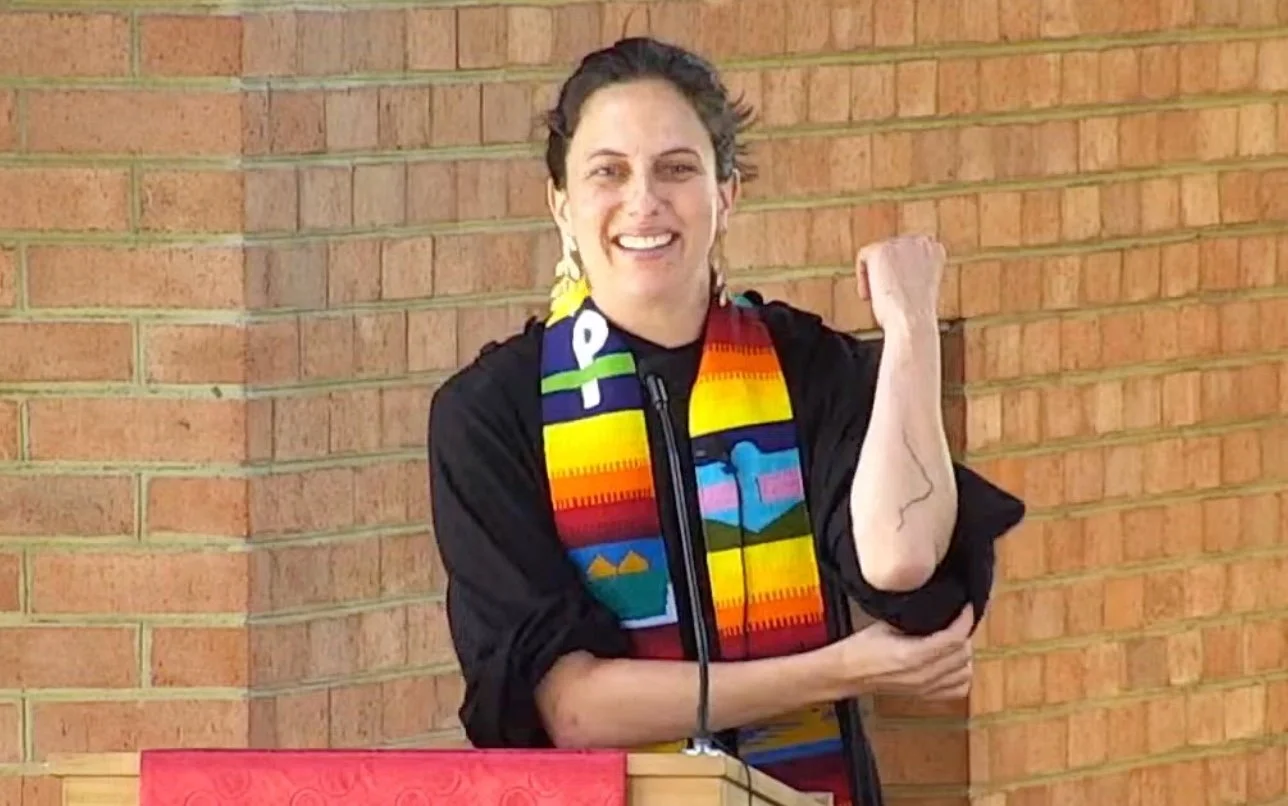
Sermon preached by Rev. Margie Quinn on Sunday, March 29, 2026
Good morning. I love all this talk about divinity schools and seminary and all that good stuff, because today my first story is about a younger Margie who had just completed her first year at Duke Divinity. Daniel, you ready?
I had asked if I could be placed in a small town for my first summer in field education placement. I wanted to be in a context that I hadn't ever experienced before, being from a big city and coming from Seattle at that time. And so I was placed in a pretty rural Methodist church in Bryson City, North Carolina. Has anybody ever been to Bryson City? It’s beautiful. It’s a beautiful, beautiful town. The Nantahala Outdoor Center is right there—lots of good rafting.
There’s also this road next to Bryson City called the Tail of the Dragon. The Tail of the Dragon is an 11-mile stretch of road with 318 curves. I didn’t believe it, so I took my 1999 Toyota Camry and drove it that summer—and had to stop and dry heave for quite some time. That is true.
A lot of people come to Bryson City to ride the Tail of the Dragon—motorcyclists, or what I’m going to call bikers. That summer, there was an annual gathering of bikers—a big cookout. And the bikers wanted a pastor to come and bless the bikes. Y’all know where this is going.
So, perched near the Tail of the Dragon under a bunch of pavilions, young Margie in her Chacos was asked to go bless the bikes. I was asked to do that because my supervisor, my pastor, was out of town. He thought it would be a very easy task for me—just go and offer a simple prayer to this group of motorcycle riders.
So I park and show up to the cookout by myself. I have a bunch of hot dogs. I’m eating pie. I’m kind of waiting for my big moment. And I’ve just had a year of theological education, so I’ve thought a lot about what I want this prayer to sound like. I want to sound smart. I wanted to pray about the hermeneutic of an eschatological world and the theodicy of God as an ecstasy reimagined with the soteriology of salvific something, something, something.
Y’all don’t know what I’m talking about. I don’t know what I’m talking about.
And I get up there to pray with these 15 guys and their motorcycles. I’m about to lay hands on a bike, and one goes, “Ah, don’t touch that. Don’t touch that bike.” And I looked around and realized, Margie, just pray something simple.
So I don’t even remember what I prayed, y’all, but it did not have the word “soteriology” in it.
In that moment, they just wanted me to bless these bikes and bless this journey. They didn’t want me to get fancy.
I went back to Duke the next year and was reading something by author Glennon Doyle. Many of you know her. In her book she said, “Don’t be fancy. Just help people.” Don’t be fancy. Just help people.
I think Mark 11:1–11—it’s not fancy at all. We know it as the triumphal entry into Jerusalem, but in a lot of ways it’s not that triumphant, is it? And I think it tells us everything we need to know about the one who came in the name of the Lord.
This telling takes “fancy” and turns it on its head. I like Mark’s version best because he directs our focus to what everyone else is doing around Jesus. It’s like what we’ve been talking about during this Lenten season—that all of these background characters in these healings and miracles are actually the ones tasked with performing the gospel.
Jesus says, “Come over here. I’m going to tell you what to do—now go be the hands and feet for me.” And that’s what’s going on in Mark’s account.
Jesus is on his way to Jerusalem. He gathers his disciples at Bethany and draws two of them in. He says, “I want you to go find a donkey—one that’s never been ridden. When you find it, untie it and bring it to me. And if anyone asks why you’re untying it, just say, ‘The Lord needs it.’ And if they look confused, say, ‘He’ll bring it back immediately.’”
So the disciples, without missing a beat, go and find this colt tied out in the street. They start to untie it, and sure enough, bystanders say, “What are you doing?” And they say, “The Lord needs it.” And the bystanders don’t bat an eye. They let them take it.
They bring the donkey to Jesus—Jesus, Lord of Lords; Jesus, Messiah; Jesus, the King. They take cloaks and put them on the back of this donkey for him to ride.
That’s not very fancy, is it?
They bring the donkey, throw their cloaks on it, and as he rides, people come from all over. Scripture says they’re waving palm branches they cut from the fields, shouting, “Hosanna!” which means “Save us.”
Wait a minute—a donkey? What happened to a king on a warhorse? A couple of cloaks? What happened to a throne? Leafy branches from the fields? What happened to a red carpet?
Where is the royal procession fit for a king?
It’s not very fancy at all.
And we know that’s because that’s not the way our King works. His kingship is symbolized by a humble colt. And as he told the disciples before this entry: “The Son of Man came not to be served, but to serve.”
That’s the whole thing.
It’s as if he’s saying, “I’m not in the business of fancy. I’m in the business of sacrifice, humility, and love. And all it takes is a cloak and a branch.”
The good news Jesus shared throughout his ministry—that he lived and preached for 33 years—built trust. So when we look at the disciples, the crowd, even the bystanders, nobody hesitates.
Mark’s gospel moves fast—“immediately” shows up again and again. And we hear it here, too. When Jesus tells people what to do, they do it. He lived among them, not above them, and they trusted him.
They find the donkey. They grab the cloak. They cut the branches. They respond.
Y’all remember that group from October—the Buddhist monks who walked 2,300 miles for peace and compassion? They took nothing with them. Nothing fancy about that.
You remember when Jesus sent out the disciples? “Take nothing—no staff, no bread, no bag, no money, no extra shirt.” Nothing fancy.
The Son of Man, cloaked in humility. Not a royal robe—but the cloak a hemorrhaging woman reached out to touch. “If I could just touch the hem of his garment…”
People in Gennesaret begged to touch his cloak and be healed. It didn’t have gold sewn into it. It didn’t need to.
Nothing fancy.
I don’t think the good news of the gospel wants us to get caught up in sounding smart or getting it perfect. We might miss the chance to pray if we’re too busy finding the right words. We might miss the chance to act if we’re too busy trying to look the part.
We don’t worship that kind of king.
He doesn’t care about our vocabulary, our accolades, our titles, what we’re wearing, how much we have, whether we made the team, got into the school, or hit our sales goals. He cares whether we will act—and not in a way that gets in the way of the gospel.
He says, “Move. Get out of the way. Do what I say. It’s easy. Don’t be fancy. Just help people.”
That’s it.
It reminds me of those Southern mothers who say, “You don’t need all that.” We don’t. We don’t need all that to go out and help someone.
So my question for you—and for me—is: What will the good news inspire you to do?
Because the irony of this story is that the same people shouting “Hosanna” will soon shout “Crucify him.” We have to decide which voice we’ll amplify.
In one of his last public acts, Jesus shows us what matters most:
Show up.
Look around.
Respond immediately.
Help.
So I don’t care about your theodicy or your eschatological soteriology, church—and I don’t think Jesus does either.
He just says, “Don’t be fancy. Just help people.”
Amen.