
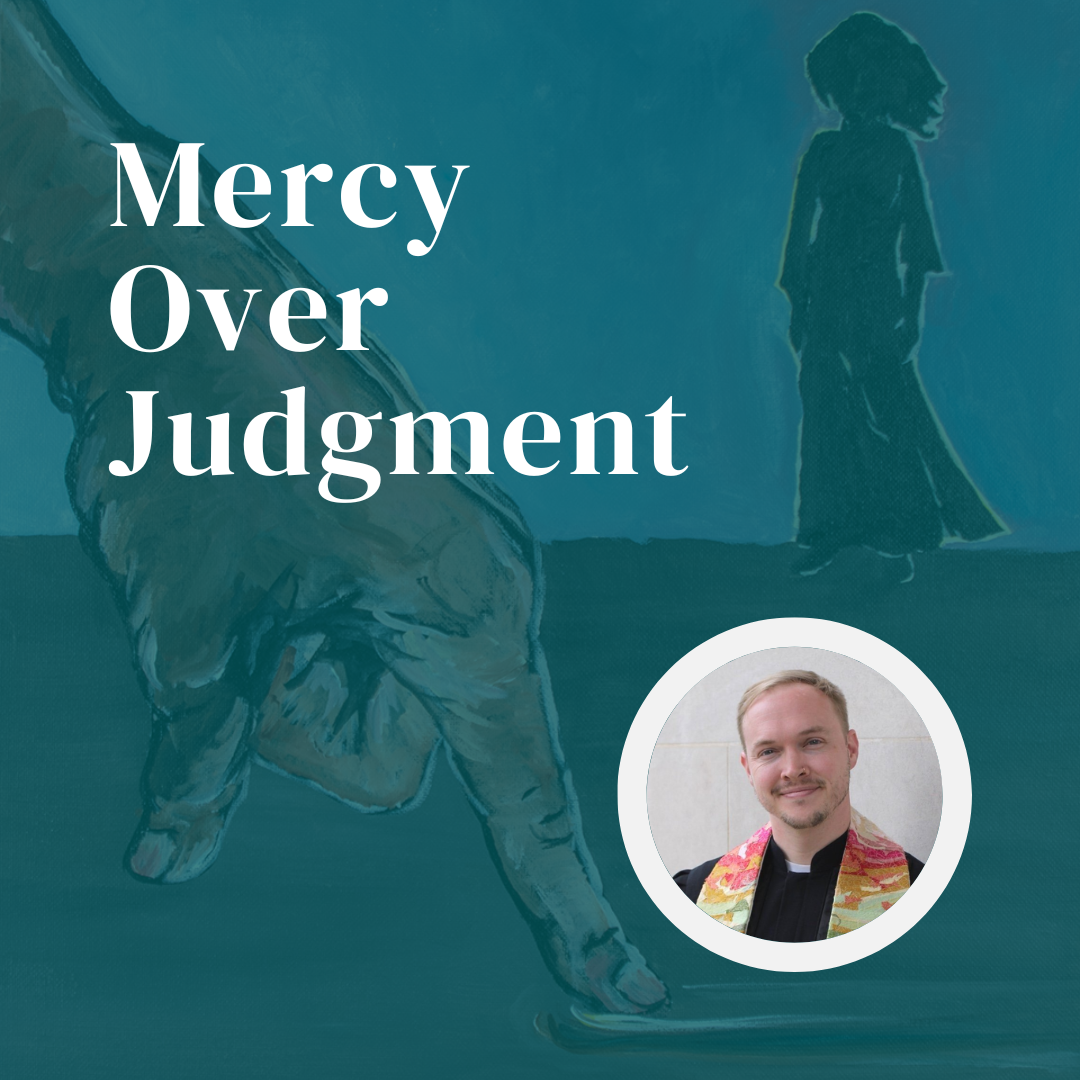
Sermon preached by Rev. Wesley King on Sunday, March 22, 2026
As we prepare for this sermon, would you please pray with me?
Holy One, when you speak, we don’t want to miss it—
when you bend down and write in the dirt,
when you move through the trees,
when you wake with the dawn,
when you tug on our hearts and whisper into our dreams.
We don’t want to miss it.
So today we pray:
clear out the cobwebs in our ears,
quiet the steady stream of thoughts that march through our minds,
and open up space in our hearts so that we can receive your word
and what it has for us today.
With hope we pray. Amen.
Recently, I wrote an op-ed that appeared in The Tennessean newspaper. The Tennessean has been very kind to publish some of my ramblings. This piece was about how we all choose which scripture verses to live by—and how that’s actually a good thing. It’s called discernment. It’s called discipleship.
In this op-ed, I gave a couple of examples of two posts I saw on Facebook regarding the U.S.’s recent bombing of Iran. One post critiqued the war from a pacifist perspective. They said that the Ten Commandments instruct us not to kill, not to murder, and they called for soldiers to refuse unjust orders.
The other post was a rebuttal, saying that we are instructed to obey authority, according to Paul’s letter to the Romans, chapter 13.
As I mentioned in the piece, both of these are biblical arguments. But what they highlight is more about the interpreter’s agenda than about the scriptures themselves.
You see, the Bible is complex. It was written and compiled by many authors over roughly 1,200 years. Of course this vast library contains contradictions and discrepancies. The Bible is not a magic eight ball. You can’t open it to a random page, point your finger, and live by whatever that verse says. That’s not how it works.
Regarding the verses above, one of the most obvious of the Ten Commandments is “You shall not kill.” However, there are other verses—such as Leviticus 24:17—that seem to permit killing in certain cases: “Whoever takes a human life shall surely be put to death.”
Similarly, regarding submission to authority, Romans 13 instructs the early church to be subject to governing authorities. Yet the prophet Isaiah says, “Woe to those who make unjust laws.”
And as I’ve mentioned before, Romans 13 has been used throughout history to justify slavery, Jim Crow laws, and segregation.
So which is it?
As we move toward Holy Week, we acknowledge that Jesus’ ministry increasingly put him at odds with religious leaders—those who prioritized legality and saw Jesus as a threat.
Our passage today tells us that while Jesus was teaching in the temple, scribes and Pharisees interrupted him. They brought a woman allegedly caught in adultery and put both her and Jesus on trial. They cited Mosaic law and placed her fate in Jesus’ hands.
But instead of focusing on punishment, Jesus flips the script, as he often does. He invites them to consider their own sin.
He knows what the scripture says—but he asks:
“What is the most just, merciful, and faithful interpretation of this text?”
It’s important to note the hypocrisy of the law itself. The law of adultery largely applied only to women. Men could have multiple wives and concubines. A man would only be tried if he defiled another man’s “property.”
The woman’s male counterpart is absent. Her accusers—her jury—are people who would not have been breaking this law themselves, yet they get to decide her fate.
We’re given no details. Was she assaulted? Threatened? Or simply bait for Jesus?
Jesus’ teachings were grounded in scripture, but his actions interpreted the law through love, compassion, and mercy.
The Reverend Lizzie McManus-Dail writes:
“The inconvenience of mercy is that it is hardly ever merited.”
And yet Jesus speaks of mercy constantly. He tells his disciples to forgive seventy-seven times. He calls the merciful blessed. Even on the cross, he says, “Father, forgive them.”
Reverend Lizzie continues:
“In John 8:2–11, Jesus embodies mercy with a woman who may have received none in her life. She may not deserve it—and yet he offers it anyway.”
Because mercy—unmerited, impractical, and full of hope—is the mark of a true follower of Christ.
Verse 6 says they were using this moment as a trap. But what does Jesus do? He bends down and writes in the dust.
What was he doing?
Was he writing a message to the woman? Listing sins? Reciting the law? Buying time?
Instead of reacting, he pauses.
Then in verse 7, he says:
“Let anyone among you who is without sin be the first to throw a stone at her.”
Then he bends down again.
One by one, they leave—beginning with the oldest—until only Jesus and the woman remain.
He asks, “Has no one condemned you?”
She replies, “No one, sir.”
“Then neither do I condemn you. Go and leave your life of sin.”
Jesus does not abolish the law—he reinterprets it through mercy.
The scribes focus on legalism. Jesus focuses on transformation—for the woman and for everyone present.
Some say the issue here is Jewish law, but that misses the point. Jesus was Jewish. This is not Christian versus Jewish—it is legality versus love.
In Matthew, Jesus says:
“You have neglected the more important matters of the law: justice, mercy, and faithfulness.”
How we interpret scripture says more about us than about the text itself.
And the Bible has been used to harm.
So I ask: What will our message be? What is our agenda?
This week, our state legislature considered bills to mandate the Ten Commandments in classrooms, require Bible reading, and track students’ immigration status.
So what good is it to look like a Christian state if we don’t act like one?
What good is Christian decor without Christian decency?
We have neglected the weightier matters: justice, mercy, compassion.
On Ash Wednesday, Reverend Margie reminded us that Lent is a season of preparation, reflection, and transformation.
As new members join this church and others prepare for baptism, we are reminded that we follow Jesus because of the good news.
And that good news must be for everyone.
It must be rooted in justice, mercy, and faithfulness—because that is what Jesus calls the most important.
Reverend Lizzie writes:
“Receiving and extending mercy—even in the most unlikely places—is how I know God is still at work.”
Mercy reminds us there is more than what hurts us.
God’s justice is not retributive—it is restorative. It is the joy of the lost being found.
That is why Jesus says, “Go and live.”
The good news is rooted in justice and mercy—but it is not automatic. We must make it so.
That is why we don’t just say “may it be so.” We say, “we make it so.”
We are the ones who create a more just, compassionate, merciful world.
So what is our message going to be?
What is our agenda?
This church has a legacy of love, mercy, and faithfulness—but we cannot rest on that legacy.
We must live it forward.
Amen.
So let us go into the world—this week and beyond this Lenten season—choosing love over hate, peace over violence, compassion over condemnation, and mercy over judgment.
Because this is the good news.
Amen. Amen.
May we make it so.