
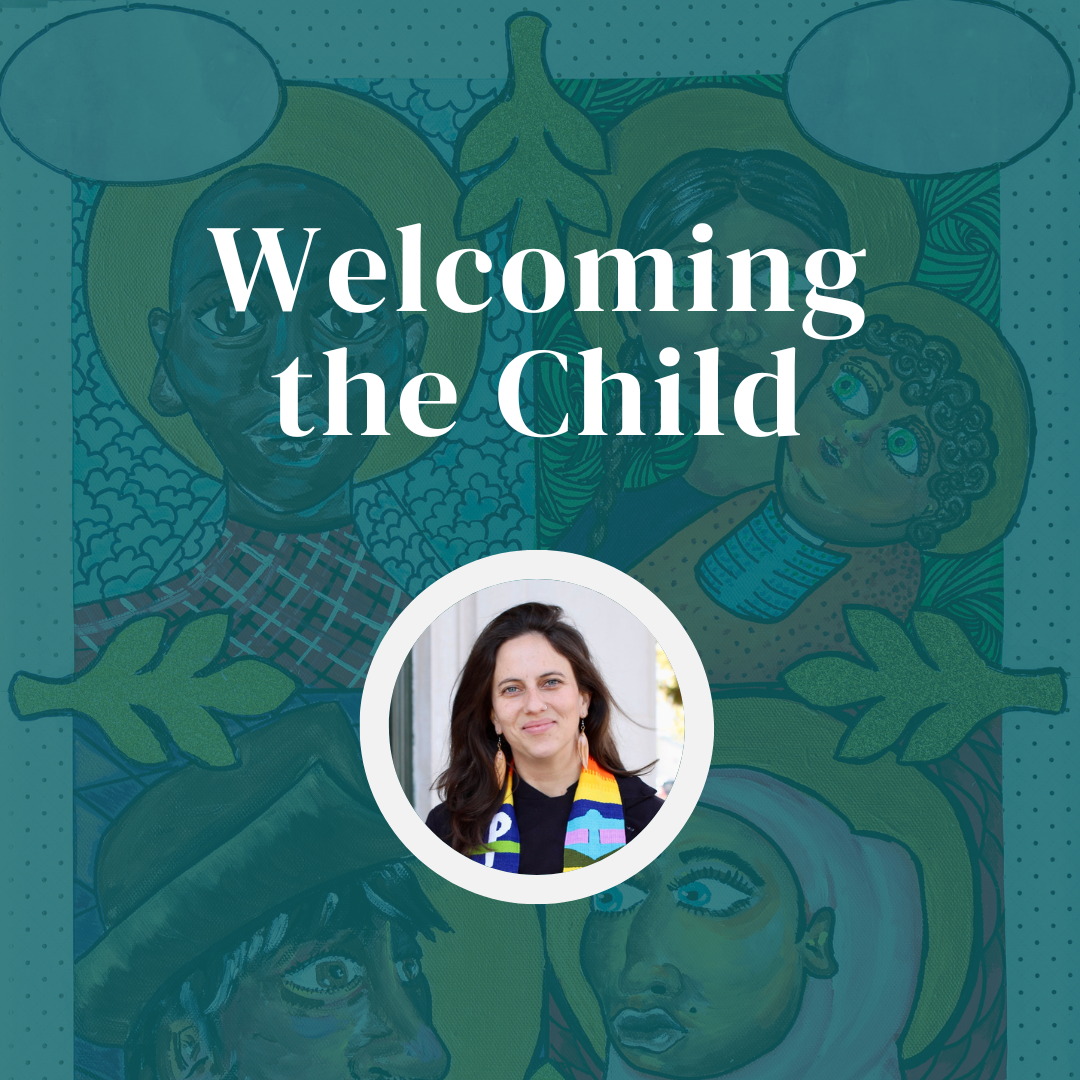
Sermon preached by Rev. Margie Quinn on Sunday, March 15, 2026
Many of you know this by now — I've talked about this exhaustively in the last couple of months — but I found my first diary a few years ago. It was a small Tweety Bird journal, and it had one of those locks on it that's fake, but I thought it was real, so my brothers couldn't open the lock and see it. And written in sparkly gel pen — y'all remember gel pens? Everyone's like, "Yeah." — written in sparkly gel pen, it said "Important Questions." This was the page right after I had listed all of the Tennessee Titans from the year 1999, which was when we had hope, you know. So, Tennessee Titans — the next page said, "Important Questions. Question number one: Who made God? Question number two: Is God really a boy? Question number three" — which I haven't talked about — "Is there life on another planet?"
I've been thinking about that little girl a lot as I step into this new role of senior minister. Her wheels were turning. Her questions were kind of the same ones that I have today. And her Tweety Bird journal was the first book she was writing in that led to her fascination with a bigger book that she would study and try to understand for decades. I'm talking about the Bible.
We know that kids say the darndest things, and kids also ask the deepest questions. On a podcast I found this week — it's called Hearing Jesus for Kids — the podcast host Rachel Gro shares questions that she has received from kids that she attempts to answer on the podcast. Listen to some of these questions: Will my pet go to heaven? What does God's handwriting look like? Why did God make Satan? Why did God make mosquitoes suck my blood? Where does God live? How old is God? What's the best way to pray? If heaven is such a happy place, why are people so sad when folks go there? Why do bad things happen if God is good?
Kids say the darndest things. Kids ask the deepest questions, do they not? And I'll admit that in my years of growing up, I sometimes forget the very children in my life — my eight nieces and nephews, the little ones here — who hold these theologically rich questions that you and I are still asking today. What's the best way to pray? If heaven is such a happy place, why are we so sad when people go there? Who made God?
Kids start asking "why" from such a young age, and then somewhere along the way, we stop asking it as much. We tense up. We become rigid. We start to feel embarrassed when we say, "I don't know." We play pretend. We seem a little too smart to ask why anymore. We shrug our shoulders. We say, "I'm not creative. I'm not an artist." A little kid would never say that. We stop playing dress-up. We stop dancing around the house. We think that kids' movies are silly, when so much of them have things to teach us adults. Can you think of any kids' movies that have done that for you? Inside Out. Zootopia. Balto. So many rich lessons in those movies.
Instead of crouching down to look children in the eye, we stand tall. We posture maturity and wisdom, dominance and absolutes. We want more families and kids in our pews, but what about the families and kids that are here that need care and nurture? And as the youth say — and I think as Jesus would say — church, we've lost the plot.
It's easy, then, to identify with the disciples in our scripture this morning, who sternly — such a good word; has anybody had a parent be stern with you? — who sternly speak to the children that are running up to Jesus. And it's easy to imagine arguing with the disciples. In Mark 9, in this same story, in Matthew 18, they say, "Who is the greatest in the kingdom of God?" It's no surprise that adults are asking about the greatest. Kids don't care about the greatest. Who's the greatest colleague? Who got the greatest performance review? And yet the disciples are asking Jesus: who's the greatest in the kingdom of heaven? And Jesus has an answer for them, and it's very short and very direct, as Jesus can be. He says, "The kingdom of heaven belongs to kids." That's what he says. He says, "Let the little children come to me, and don't stop them."
In this account in Mark 10, Jesus continues: "Whoever welcomes one such child welcomes me. And whoever welcomes me welcomes the one who sent me." Whoever welcomes a kid welcomes Jesus. Whoever welcomes Jesus welcomes God. Are you following this? So through the transitive property — I think that's what it's called — when we welcome kids, we welcome God. It's that simple. And yet we have made it a little bit complicated. So the good news this Lent is that welcoming kids is welcoming the one who came to us as a vulnerable baby.
These words — welcoming kids — they might feel kind of cute to us today, but they would have felt very destabilizing and perplexing to the disciples. Why? Because kids in Jesus's day weren't like they are now. Children weren't how we think of them. Michael Joseph Brown notes that "children and childhood in antiquity was different." Fifty percent of kids died before the age of five. The weakest members of society were kids. They were fed last. They received the smallest and least desirable portions of food. They were the first to suffer from famine and war and disease and natural disasters. Many — some say more than 70% — would have lost a parent before they hit puberty. A minor had the same status as an enslaved person, and it was not until adulthood that they became what we might think of as a free person.
In other words, in Jesus's day, children weren't the main event. They were the side items that would be useful later on — when they were able to care for their parents, when they were able to work in the family business, when they were able to bring money to their family from a marriage dowry. Children were more often treated as slaves than family. It's so hard to fathom that.
And so this story — it's not only an illustration, it's a metaphor pointing us toward the least and the lost and the last in the kingdom of God. The ones that God wants us to be the most attentive to. The ones who lack societal status. Not just children, but anyone vulnerable and in need of care and protection.
I think this is also illustrated in Deuteronomy, which Lydia read — and thank you; I love the way you emphasized "the alien," or what we might think of as the foreigner, the sojourner, the immigrant — the immigrant, the orphan, and the widow. A litany repeated four times in just five verses, as if God is trying to get us to wake up to these populations that are in need of our attention and care and protection.
"Do not deprive them," we read. "Don't hoard your sheaves in the field. When you drop one, leave it. Leave your abundance for the immigrant and the orphan and the widow. And when you have olives left on your olive trees, don't pick them all — leave some for the immigrant and the orphan and the widow. And when you have grapes in the vineyard, don't pick them all — leave some for the immigrant and the orphan and the widow. And you do this to honor me, and because you must remember that you were vulnerable too. That you were enslaved in Egypt and I set you free. Don't forget that you experienced oppression. And so you don't get to sit on that and say, 'Whew, that's over.' You get to look around and crouch down and wonder: who else needs care?"
And this isn't a suggestion in Deuteronomy. It's a commandment. That word appears twice: I command you to care.
So, while children and immigrants and widows and orphans are named in our scripture today, I think we're invited to remember that each of us has been vulnerable at some point in our lives. We have needed care and protection. We have needed attention and respect.
Jesus is talking to kids, yes. But as priest Joanna Cybert writes, he's also talking about the ones in this world with no status, no influence, no income — like the working poor and the homeless, the people with disabilities and mental health issues, the LGBTQ teenagers who tell their parents who they are and are kicked out of their houses. He's talking about immigrants and abused children and vulnerable elderly people and abused men and women, people in the throes of this dreadful war. God is daring us to welcome all as bearers of God.
Joanna said this, not me: to believe that God's hierarchy is the reverse of culture's hierarchy. I want to repeat that because I need the reminder. God's hierarchy is the reverse of culture's hierarchy. The good news is so hard.
Church, we've got a bill in our legislature right now where people want to track and surveil kids who are immigrants. Imagine going to school in that kind of fear. We've got missiles that destroyed a girls' school in southern Iran, killing over 150 girls. We've got kids going to school in a synagogue this week, just trying to go and learn, that synagogue interrupted by an attack. And of course, one zip code over, we've got kids lacking the resources to thrive and flourish — to be quite literally fed.
We have got to care for and seek protection for and welcome children, knowing that in doing so, we welcome God. God who — remember this — called the prophet Jeremiah, who was around ten years old, just a kid, we might say. God called the prophet Jeremiah. God called Jesus, who shows up as a baby, who is found at twelve years old in the temple wrestling with scripture, talking about scripture with his teachers. I think there's a reason that story is in scripture.
God called a refugee and a little one, and had no hesitation when Jesus grew up that he wasn't supposed to sternly talk to kids. He was supposed to welcome them in, lay hands on them, and bless them, knowing that they are the face of God.
So, church, our job is yes — to care for those who are overlooked, to care for those who are also looked down on, because God reminds us we were once overlooked too. Our job is to learn the names of our little ones in this church. Our job is to nurture their faith. Our job is to volunteer as Sunday school teachers if that calls to us. Our job is not to look down on, but to crouch down. To say, "How are you?" And not only to ask them questions, but to hear theirs too. To learn from them just as much as we may think we teach them.
Kids say the darndest things, and kids ask the deepest questions. And when we welcome children — when we welcome the child in us, when we grab a kid's bulletin and color, as I know some of the adults like to do — when we welcome that child in us, we welcome God. And that's important too.
The good news that we are grounded in this Lent is that we love and believe in a God who offers care and protection for the most vulnerable. But we don't watch God do that. We join in God's work doing that.
So, church, hear these words from the prophet Isaiah — called to be a prophet probably around the age of 18 — who said: "The wolf shall live with the lamb. The leopard shall lie down with the young goat. The calf and the lion will feed together. And a little child will lead them."
Amen.