
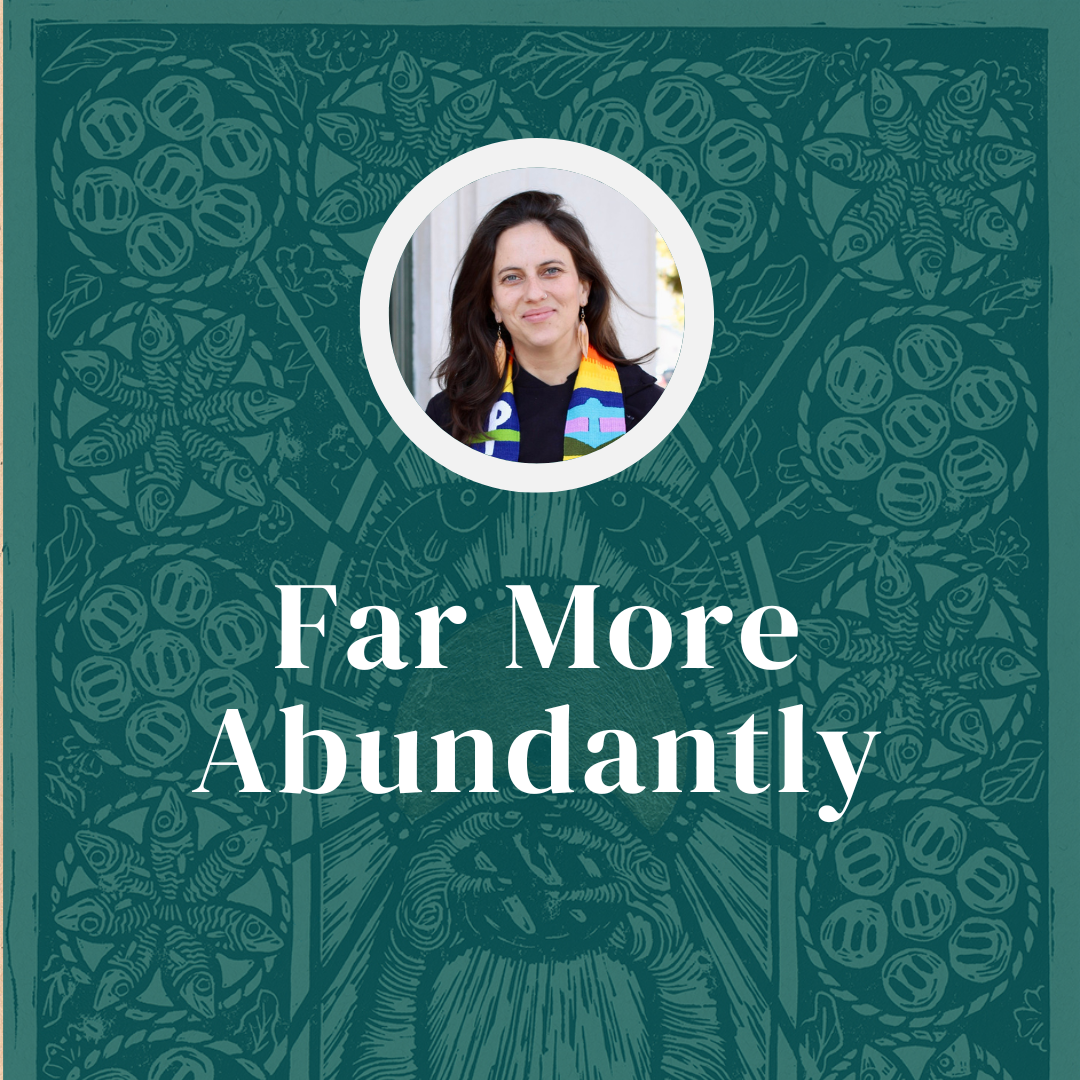
Sermon preached by Rev. Margie Quinn on Sunday, March 8, 2026
Before we get to this passage, something really terrible has happened. Leading up to it, we learn that John the Baptist has just been beheaded. It's a passage that you probably won't hear preached on; it doesn't come up in our lectionary, but I think it's important to note before we get to this miracle.
The disciples have learned of this—have learned that he has been beheaded for the person he was, for the work that he did. And so they go to him, and they take his body and they lay it in a tomb. Then they gather around Jesus, telling him what they've been up to. And perhaps they do talk about anointing the sick and casting out demons and healing those that nobody else wanted to touch. Maybe they also talk about how he told them they weren't allowed to take their bag or their bread or any money on the journey. Perhaps they lament to him about this friend that they lost.
I wonder if one of them, in sharing, was kind of like a teacher's pet—trying to display his work and prove that he had done enough, that he had healed enough and cured enough, looking to Jesus for that affirmation like some of us may have done with our favorite teacher. And maybe one of them was just ragged and tired, his head hanging low, feeling shame that he hadn't made Jesus proud, that he hadn't done enough—that he had tried his best to heal as many as he could, but he had still walked by people in need.
Maybe one of them was on fire, totally galvanized by the work that they were doing, ready to sprint off and continue it. Maybe one of them was resentful, with blisters on his feet and this audible hunger, looking at Jesus like, "This is what you're having us do? This is the kingdom work?" And maybe all of them in that moment were also heavy with the death of their friend, afraid of what it might mean for them to show their loyalty was not to Herod, but to a different kind of king.
This is where the disciples are when we get to this miracle. Do you feel that sense of raggedness? Do you feel that exhaustion and perhaps fatigue?
Knowing Jesus, knowing the person and the Savior he is, he perhaps had compassion on them. I think he did, because he invited them to go to a deserted place. Maybe he knows that we have to rest in the midst of the work. And so it says that many were coming and going and they didn't even have the leisure to eat. Maybe he wanted them to have the leisure time.
So perhaps with a relieved sigh and that feeling—y'all know that feeling of being at home with someone who loves and sees you—you can just deeply exhale and lean into that comfort. They take their weary bodies and they crawl into a boat to go out to a deserted place and find that respite. And before they can even remove the sandals from their feet and rub the calluses and maybe the bunions, people recognize them. And the people actually beat them to the place where they were going to rest.
And Jesus—perhaps leaving the disciples in the boat to look at each other and say, "There he goes again"—he walks to shore. Scripture tells us that he looks on the crowd with compassion. They were sheep without a shepherd; they were a flock without food. And we learn that he begins to teach them many things.
Can you imagine being there and hearing what he might have taught? What did he teach them? Did he recount his stories of the wedding at Cana, of the hemorrhaging woman, of the demoniac? What did he say to them? Rocking on a boat, getting spiritually fed once again by the one who embodied compassion. Perhaps the disciples were starting to regain that spiritual energy that they so desperately needed.
Whatever he said, he talked into the night—which I'm not going to do right now. It says that he talked into the night. It says that it grew late. And so perhaps these seasick disciples rocking in the boat and the crowds—well, they're listening to the Son of God. I would hope to be pretty alert, taking mental notes, but he is preaching and he is preaching.
And so finally they say, "Hey Jesus, this place is deserted. Not that people went away, but it's deserted and it's late. What if you just come with us and then have these people go and find food for themselves in the villages and in the surrounding country?"
And he answered, "You give them something to eat. You give them something to eat. You give them something to eat." The teaching portion was over. The speaking into the night had ended. And Jesus, the one with the divine power, did not perform the task himself, but empowered his disciples to do it. Do y'all hear me there? He empowers them to show everyone what Good News looks like. "You go give them something to eat."
"You want us to buy bread? Well, you sent us out without money and without a bag and without anything on our person. It's impossible."
Jesus has presented them with what we may think of as an impossible task. Then he says, "Okay, well, what do you got? What are we working with here?"
Five loaves and two fish. That's not even enough to maybe feed just these front rows of people right here. What didn't seem like enough for the disciples somehow was more than enough for Jesus. What seemed impossible for them became this grand holy possibility for him.
And then he says, "You—not me—you go get all of these groups of people to sit down on the grass." And so, we're not talking about the size of this congregation today. We're talking about 5,000 people that they had to organize and mobilize. You know something about mobilizing and organizing people? It's not easy work. 5,000 people. I have a friend moving to Pleasant View, Tennessee. Population: 5,000 people. Trying to put it into perspective for you.
You go organize the people, and the people are still there. The people have seen five loaves and two fish and the people stick around, waiting after hearing what this man has said to see if he really is who he says he is. And I bet a lot of them thought, "He's got this."
And so the disciples go out to the crowd. Jesus takes the food. He blesses it. But he's not the one who goes out and feeds them. He doesn't ask them to come forward so that he can share the loaves and fish with them. No, the one with power empowers the disciples to go and share the Good News—to see a crowd in need and be nourished by their gratitude as they nourish them with food.
And all ate and were filled. Man, if we could etch those words on that table: And all ate and were filled.
And Jesus, whose first miracle was to make wine overflow with abundance, shows them that, Church, there is always enough in the Kingdom of God. And all ate and were filled—yeah, by food. And we talk about that a lot in this miracle. But perhaps they were filled by other things. Filled by touching the hand of a disciple who passed them a loaf. Filled by the eye contact of one who perhaps also embodied compassion. Filled by seeing neighbors and strangers also being fed. Filled by being together in one place. Filled by seeing this shepherd feed his flock. Filled.
What I love about these stories in this Lenten season, and what is so convicting to me, is that Jesus is working out of the spotlight. So, he wouldn't be here; he's working out of the spotlight to bring the Good News to people. He is a "secret agent Savior." He doesn't need to be the one recognized and rewarded. In fact, he is telling us something about how miracles work—how the impossible becomes possible. He empowers the servants at the wedding just as he empowers the disciples at this feast to share the goodness.
There are so many of you who I've thought about this week as I've thought about secret agent stewards. So many of you who are working outside of the spotlight to make this community flourish.
You who iron the paraments—you bring in your iron from home and iron the paraments and the cloth as we change them over every liturgical season.
You who write birthday cards to most members of this congregation without expecting anything in return.
You who hand me grocery cards every Sunday—you know who you are, and you've asked to remain anonymous—and you say, "Share them with people in need."
You who purchase lighters for lighting this Christ candle when you saw me and Wesley struggling for a couple weeks—we couldn't get it working and then just gets awkward and we're up there for more and more seconds—and you hand me a bag of lighters that you purchased and say, "Okay, that's getting old. Use these."
You who pick up the scattered bulletins after the service and grab the trash to throw away.
You who made soup and cornbread for us during the ice storm.
You who stand in the back, making sure that our online viewers can be a part of this community—those who are sick, those who can't make it here today, those who live in a different state and want to be a part of what Vine Street is up to.
You who change light bulbs on ladders.
You who volunteer in our nursery when one of our workers is sick.
You who stay after every event to clean the kitchen, to wash tablecloths, to put chairs away.
You who buy the donuts every week so that we have a sugar rush as we wrestle with Scripture.
You know who you are. Doesn't matter about the spotlight. A church is the people who are stewarding in secret. A church is made of disciples. A church is made of people who hear this story and trust God's abundance and say, "There is enough if we make it so." And we don't have to do it alone, but it is up to us to do it—to participate in the work of Jesus.
And you all remind me that the one we follow—yes, he preached in front of crowds, but a lot of the Good News he shared was behind the scenes. He says, "You give them something to eat. You fill the vessels with water, and I will figure out a way to turn it into wine. You go tell the disciples that I have risen, Mary. I could do it—I am fully divine—but I'm trying to tell you something about community: that the impossible is possible together. It doesn't happen alone."
The miracle requires group participation. How many of you hate group projects? Faith goes, "Me too." And yet the miracle requires it.
And for those of you like me who relate more to the disciples than perhaps the secret agent Savior, I think we need that holy nudge. This Lent, as Reverend Verzola says, Lent is not about watching Jesus work. It's about participating in the work that Jesus is already doing. I want to repeat her words: Lent is not just about watching Jesus work. It's about participating in the work that Jesus is already doing.
All ate and were filled because the miracle became possible through the power of community.
So I got to wonder where God is inviting you to participate in the Good News this Lent.
On Ash Wednesday, I thought I had really messed up. I have never mixed the ashes with the oil before. This was my first Wednesday to do that. And so I got here early and I took the ashes that we burned from the palms on Palm Sunday, if you didn't know that. And I took the oil and I went down to the kitchen. And many of you know that I can't bake, but Kathy wants me to try to bake a cake for the Festival of Cakes to perhaps empower me ("You give them something to eat"). Nobody buy my cake, okay?
And I look at the ashes and I look at the oil and I just make a guess. Later, right before people processed, Wesley comes up and I've given him the bowl of the ashes and oil that I mixed. And he looks at me and says, "I don't know if this is right. It's like... gloopy." Y'all wouldn't even know what goes on behind the scenes! And I freaked out and my stomach dropped. "Oh my gosh, I'm not good enough. I'm not like the man who led before me. Gosh, I messed up this sacred ritual that is serious. We're talking about ashes and dust."
And people walked toward us and I did my best to remain present, but I felt a small sense of shame that I hadn't prepared well enough. And all the while, people continued to come forward to receive their ashes. And a man I'd never seen before was one of the last to come forward. And I imposed the ashes on him.
And I sat down thinking about my "concoction," we're going to call it. And he came up to me after the service and he said, "I am in Nashville for just today. I have been at Sarah Cannon Cancer Center and I have Stage IV gastric cancer, and I found out today that the clinical trial failed and I have some very, very hard decisions to make now. Receiving these ashes means more to me than you will ever know."
We participate in the work flawed, and then we let Jesus be Jesus.
We mix the oil with the ashes and we show up and we let God work. And we crawl out of the boat with all of our human gifts and flaws and we look to the one who just empowers us to do the best we can. Whether we're weary or galvanized, whether we are exhausted or in grief, we show up. We let Jesus be Jesus.
Because the Good News, Reverend Lizzie McManus-Dail writes, is that what the disciples have to offer is enough. What we have to offer is enough. The Good News is that the disciples' limiting beliefs do not limit what God is up to. The Good News is that everyone's fed. And the Good News is that the impossible becomes possible together.
God doesn't start with the problem—"How do we feed these people?" God starts with what God has, which is everything held in God's hands. And God starts with what God has given us, which is five loaves and two fish.
So our work is simple: Participate in the Good News this Lent while also letting Jesus be Jesus. We can follow in his footsteps. We can do works in secret with a reminder that the good wine and the long table and the many loaves—that's Jesus laughing at the impossible. That's him not shuddering from this "not-enoughness." He's not scrambling with scarcity; he's leading with abundance. And he's showing us that we never have to do it alone. We get to do it together.
And that's the miracle in this story, Church. So, how will you participate with me in crawling out of that boat—maybe scrambling out—showing up, offering what you can as he tells us: "You... you give them something to eat."
Amen.