

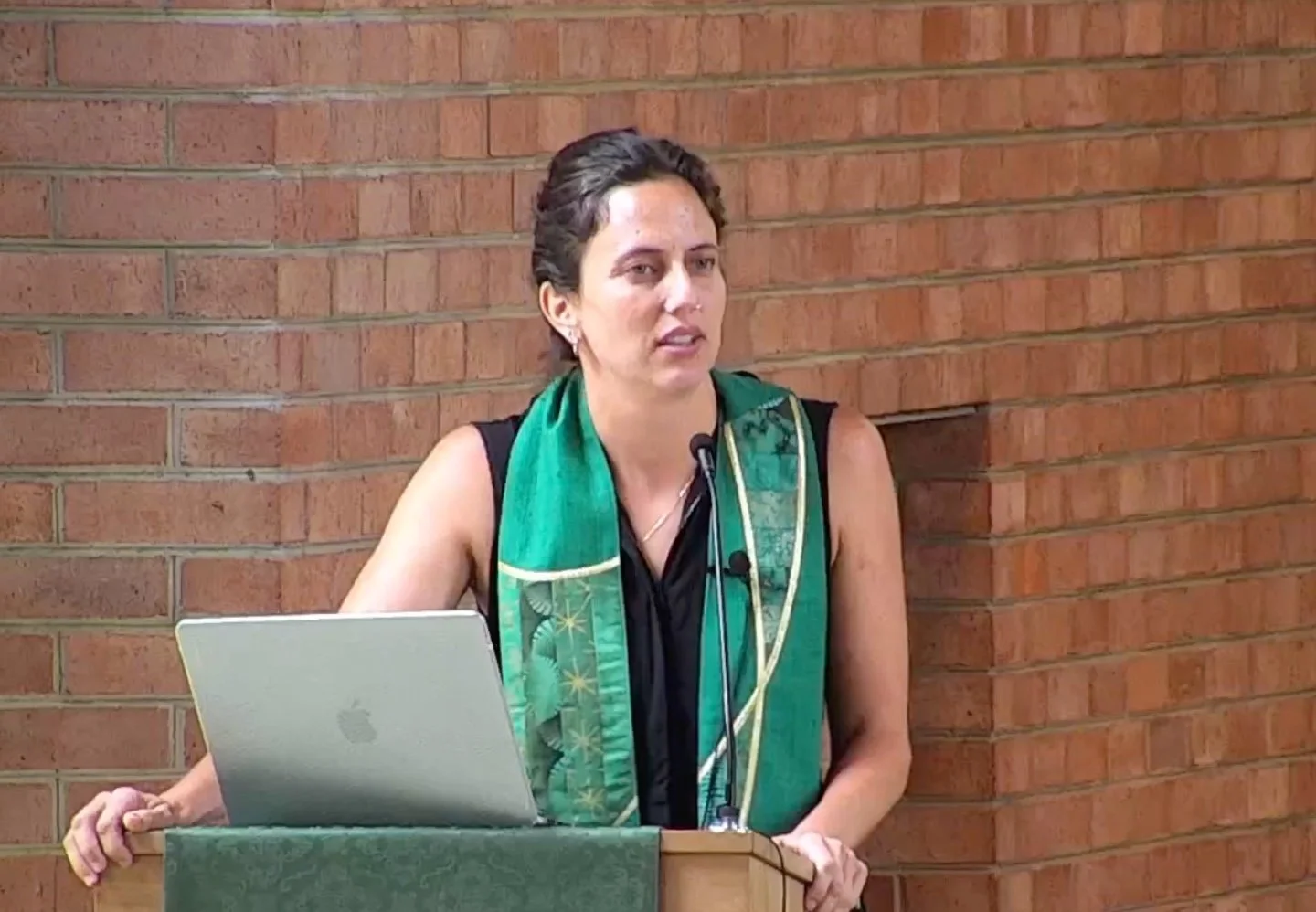
Sermon preached by Rev. Margie Quinn on Sunday, June 21, 2026
For those of you who don't know me, my name is Margie, and I come from one big, happy, perfect family.
My mom is out of town this week, so I'm going to talk about our one... No, I'm just kidding. Unlike Sarah and Abraham, my one big, perfect, happy family has no history of marital strain. We have never had issues with inheritance. We have never had the pain of stories of infertility. We have never dealt with sibling favoritism in my one-of-six-sibling household. We haven't dealt with the complexities of blended families. No, we are one big, happy family. And you already know that's not true. And you already know that's not true for you either. Amen. We've been journeying through Genesis together, looking at the stories of Abraham and Sarah and Ishmael and so many others who show us just how human and relatable these ancient figures in the first book of the Bible are. I have found it helpful and heartwarming to read stories where I see myself reflected in some of these characters and some of these interpersonal dynamics and some of these wrestlings with God. But today what I read is actually to me the most heartbreaking story in scripture in all 66 books of the Bible. When I read this particular passage, my heart breaks every time. Last week, we hinted at this resentment that the woman named Sarah may have felt for her husband Abraham around the birth of their son, Ishmael. I didn't get too much into it then, but today before we even get to the passage that Jim just read, we have to go back a little bit to Genesis 16, because that's the origin story of the birth of Ishmael. For those of you who don't know, we learn that Sarah was barren. She couldn't have a child. And for women at that time in that culture, their womb was their identity. It was their power. It was how they carried on the family lineage and legacy. It was how they had worth in their household and in society. And she couldn't bear a child.
So she goes to her husband Abraham and she says, "You need to go into our slave girl Hagar and conceive a child for us, because the Lord is not going to do it for me." And he did as he was told. And the slave girl Hagar conceives. And when she sees that she has conceived, scripture tells us that she looks with contempt on her mistress. She looks with contempt on her mistress, on what Sarah demanded Abraham do to her and on what happened and would happen after.
And Sarah sees this and she turns to Abraham and she says, "May the wrongs done to me be on you. I gave my slave girl to your embrace, and now she looks at me with contempt." Abraham said, "Your slave girl is in your power. You do with her what you want." Taking the back seat to this story. And it says that Sarah dealt with her harshly. And so Hagar ran away. Hagar ran away into the wilderness. And all of a sudden, the angel of the Lord appears. And the angel says, "Where have you come from, Hagar? And where are you going?" And she says, "I'm running away from my mistress Sarah." The angel says, "This is hard, y'all." The angel says, "Return to her and submit to her. I will so greatly multiply your offspring that they cannot be counted for multitude. You will bear a son, and you will call him Ishmael, which means God hears." So Hagar, hearing this, looks up at the angel of the Lord, or looks up at the Lord — and Hagar, who is the only figure in the Bible to have the audacity to name God, which is for a whole other day, we'll get there — says, "I'm going to give you a name, God. I'm going to name you El Roy, which means God who sees," and in some translations, "God who sees me." El Roy, she said, "Have I really seen God and remained alive?" As if that can really happen.
That is the origin story of the birth of Ishmael. And you hear in it the heartbreak, don't you? You hear the jealousy and the resentment. You hear this mother who's so heartbroken that she can't have a child of her own that she pushes out the slave girl that was forced to have a child for her. And you see, perhaps, threaded into this story, Abraham's passivity allowing the women to be pitted against each other and deal with it themselves. You hear all of that?
Now we jump to our story today. In our story today, that baby boy Ishmael, named for the one God hears, is a teenager. He's about 13 or 14 years old. And maybe you can try to think through this with me. What would it have been like — since we don't know in the text — what would it have been like for Ishmael growing up? Would Sarah have looked on him with contempt too, being reminded of the way that he came into the world, of what she couldn't do? Would she have just loved him as if he really were her own son — a tenderness that some mothers have told me they didn't know existed within them until they gave birth? What about Hagar? Is she serving this family, watching them raise her child? Is she able to reveal to him who she really is at this point? There's so much that we don't know and don't get to hear. And as one theologian said, God has other stories, just not the ones written down.
So at this point, Ishmael is about 13 or 14. And Sarah has Isaac, who God promised. Isaac, which means — who was here last week? What does it mean? Do you remember? Oh, somebody said it. God laughs. Y'all are going to start getting a test on the back of your bulletin.
So Sarah has Isaac, and about two years into Isaac's life, they have what's called a weaning feast day. It's a kind of celebration for Isaac being weaned off of Sarah's breast. It's a big day of celebration in ancient culture. And Sarah sees Ishmael playing with Isaac. Just a teenage boy playing with his brother. She sees Ishmael playing with Isaac. And actually, what scripture tells us is she says she sees the son of Hagar the Egyptian playing with her son.
She's not calling him his name anymore. She sees the son of Hagar the Egyptian playing with her son. The verb there is actually "Isaacing." Ishmael is laughing with his baby brother and playing. Sarah doesn't like it. So she grabs Abraham. She says, "Abraham, come here." She says, "Cast out Hagar immediately. The son of this slave woman shall not inherit along with my son Isaac."
That is a loaded sentence, is it not? "The son of this slave woman shall not inherit along with my son Isaac." Sarah, somewhere along the way, believed that God would not have enough for both boys — that God's promise of this offspring that would be multitudes, numbering the stars, that it wouldn't be enough for both. Sarah, as many of us do, had come to worship scarcity and question God, and be skeptical that God really could love and provide for both boys. And so, once again, Hagar — a woman who has done nothing wrong — is cast out. The first time she flees; this time she is made to go. And we learn, in a really human moment, that this matter was really distressing to Abraham. It says this matter was really distressing to Abraham on account of his son, on his son Ishmael, and on Hagar.
God says to Abraham, "Don't be distressed because of Ishmael and Hagar. Whatever Sarah says to you, do as she tells you, for it is through Isaac that offspring shall be named for you. And as for Ishmael, don't worry — I will make a nation of him, because he is your offspring too." You see what God does there? There's enough, and there is abundance, if we are patient enough to see it.
Abraham gets up really early in the morning and wakes up Hagar, and grabs bread and a skin of water, and in this really tender moment, to me, gives Hagar the bread and actually puts the skin of water on her shoulder, and then he sends her and Ishmael away. And what was he feeling then? A woman that he has been intimate with. A woman with whom he shares this heartbreaking, complicated story of joy and pain. A woman who, in some ways, has given him one of two boys that he loves unconditionally. Is he ever going to see her again? Is he ever going to see Ishmael again — his son? We don't know. We actually don't know.
So Hagar leaves. She wanders in the wilderness for a very long time. She runs out of bread. She runs out of water. And so she takes her teenage boy, her baby boy, and she hides him under a bush. She sits opposite him, pretty far away. And she says, "Do not let me look upon the death of my child. I'm not doing it." And then — and this is so interesting, too. Isn't the Bible interesting? It just kind of is. Okay, this is so interesting, too. We learn that an angel of the Lord appears again, and it says, "The angel heard the boy." The angel heard the boy. So what was Ishmael praying under that bush? Or was he crying and the angel heard it? Or was he whispering his own prayers — please save my mom, please help me? The angel heard the boy and then calls out to Hagar and says, "What troubles you? You don't need to be afraid. God heard the voice of Ishmael. Lift him up. Hold him fast. I will make a great nation of him." And then God — El Roy, the one she had named, the God who sees — God opened her eyes, and all of a sudden there appears to her a well of water. Abundance, life again — a wilderness resurrection moment, is it not? And so she fills up this water skin. And like many parents do, before she even takes a drink of water, she gives it to Ishmael. And then we learn that God was with the boy as he grew up in the wilderness and as he became really skilled with a bow and arrow. Kind of sounds like John the Baptist to me sometimes — like the wild child.
I wanted to spend time telling you those two vignettes because they are stories that need to be told. They are stories that make me ask a lot of unanswered questions — to God, to myself, to Sarah, to Abraham. They are stories of this complicated, broken, blended family that is desperately trying to be faithful and getting it wrong a lot. My family knows nothing about that kind of family.
It is easy for me to villainize Sarah. Does anyone feel that way? It's easy for me to villainize Sarah. But theologian Reita Williams talks about, in her culture, a woman's womb was her destiny — that Sarah, even though she had social standing, that she had some money, that her and Abraham had material possessions and they had slaves, that she may have had that social standing, but she didn't have respect. And there's one part in the book of Genesis that describes Sarah as beautiful, but it didn't matter. She was barren. She had material abundance, but she didn't have offspring. The one thing that she craved, the one thing that would have given her power, was the one thing that this seemingly powerless slave girl could. It's tricky. It's tricky. Hagar had been a powerless slave, but then all of a sudden, given her gift of fertility, she becomes Abraham's wife. She has this newfound power with Sarah. And so often, when two people experience some kind of brokenness and oppression, instead of looking up at who is doing it to them, they look at each other and feel pinned against one another. I know I have acted like that with women.
A lot of womanist theologians — womanist just means Black feminist — a lot of womanist theologians read this story and immediately feel this haunting memory of how this is reminiscent of Black slave women and white mistresses during American slavery. Dolores Williams, Reita Williams — I mean, they have so many commentaries on this, on these harrowing accounts of slavery. Slave masters would assault enslaved Black women, and then those women would be beaten by the white wives who were resentful. These enslaved Black women were often forced to be surrogates and take care of the white children, not being able to nurture their own. Even if the enslaved women weren't forced into these sexual assaults, sometimes they conceded to them to protect their family, to protect the ones that they thought might be sold away.
But we know that powerlessness does not unite the powerless. That harrowing history of our country, and in this scripture, teaches us how not to be. Sarah and Hagar are portrayed as rivals, which is too often a narrative we still see in our media today. Sarah just wants some sense of control and dominance. But in doing that, she oppresses a woman who is just one sister away from being a source of healing or comfort.
The mercy that God shows to Sarah by granting her a child in her womb, by giving her Isaac, is a mercy that she can no longer find in her heart for someone like Hagar.
It's ironic — Hagar, this Egyptian slave — and we didn't talk about Genesis 12 the last few weeks, but in those passages, Sarah is actually a slave of Pharaoh's. So she's experienced this same kind of oppression and forgotten it.
There's so much happening in this story. I've just touched on a little of it. There's these themes of divine favoritism that we see with Cain and Abel, and Jacob and Esau, where it often really does feel like God favors the second child and not the first child. Is anyone the first child? Yeah. I mean, the first child sometimes gets the money, or the heir of legacy, or whatever may have it, in scripture at least. God seems to choose the second child, the underdog, sometimes. Why does God do this? This problem of unfairness, as a theologian called it, in which we see time and time again siblings pitted against each other out of a disbelief that God's covenant really could be a promise for all — that there really could be enough to share. And so then we see violence and estrangement, and jealousy makes complete sense to me, because these questions from back then are still questions today. Like, who gets what money and what material benefits? Which sibling deserves what? Which brother deserves the covenantal promise and which one doesn't? Why do we value some women who can have offspring and not others who can't? What do we do about these complicated blended families? How do we talk about the complexities of growing up in those? Those are questions in Genesis, and those are questions at Vine Street Christian Church.
And I've got to know — what's God doing here? God could have easily said to Abram, Abraham and Sarah, "There's no need for your anger, because I have a plan for Ishmael and I have a plan for Isaac. They are both fruitful and abundant plans. You don't need to worry. The boys can grow up and laugh and play with each other." Why does God tell Hagar to go back and submit to Sarah? Why does it feel like God, in some of these stories, insists that we suffer before we're rewarded? And I invite me — and I also invite you — to just throw up these questions at God, because these two stories in particular, from Genesis 16 and 21, leave me with a lot of them.
What happens next is a little bit of a question mark. We know that Hagar and Ishmael go off. We learn that Hagar finds an Egyptian wife for Ishmael to marry. Then, really interestingly — yeah — we don't know if Ishmael ever sees Abraham and Sarah again. We don't know if him and Isaac ever see each other again. All we have is one verse: Genesis 25:9, which is going to be on the test next week. In Genesis 25:9, we learn that Isaac and Ishmael met together to bury their dad.
They saw each other again. Was it for the first time since that banishment? Was it cold? Was it tender? Were there words spoken? Was there healing? Was there bitterness? We don't know. We know that they met in brutal, heartbreaking circumstances to bury their father. Who knows how Ishmael viewed Abraham by that point?
Maybe they hugged. Maybe they tried to understand, and maybe they just couldn't.
Genesis may feel like a very old text, and it is a text of one big, complicated family — of which I am one. It's complicated. It's heartwarming. It's heartbreaking. It's bewildering. And it is the story that many of us have lived. Many of us still hold these unresolved questions — not just for God, not just for scripture, but in our own family systems, in our own lives. Why? Why was there favoritism? Why did the inheritance go this way? Why was there jealousy? Why is there brokenness? Why couldn't we have learned to reconcile? Why can't we see eye to eye?
We have been journeying through this book, and we will continue next week. I gave Wesley the Abraham-sacrificing-Isaac passage, because I didn't want it, and that's what I get to do now.
And again, a story that might feel so foreign and ancient, we'll learn next week has so much to do with us.
So I invite you this week, just like every other week this June, as we've been journeying through this book — however hard it might be, or freeing — where are you in it? Are you someone who takes a backseat and lets other family members fight it out? Do you feel like you're in the wilderness? Do you miss your boy? Do you feel jealous of what others have that you don't? Where is God in it all? Is God the one who sees you? Is God the one who hears? Or are you just not sure? Today, I'm asking myself the same thing. And friends, this is a place where we know what it's like to be wilderness people. You are always welcome into these complicated stories. Amen.