

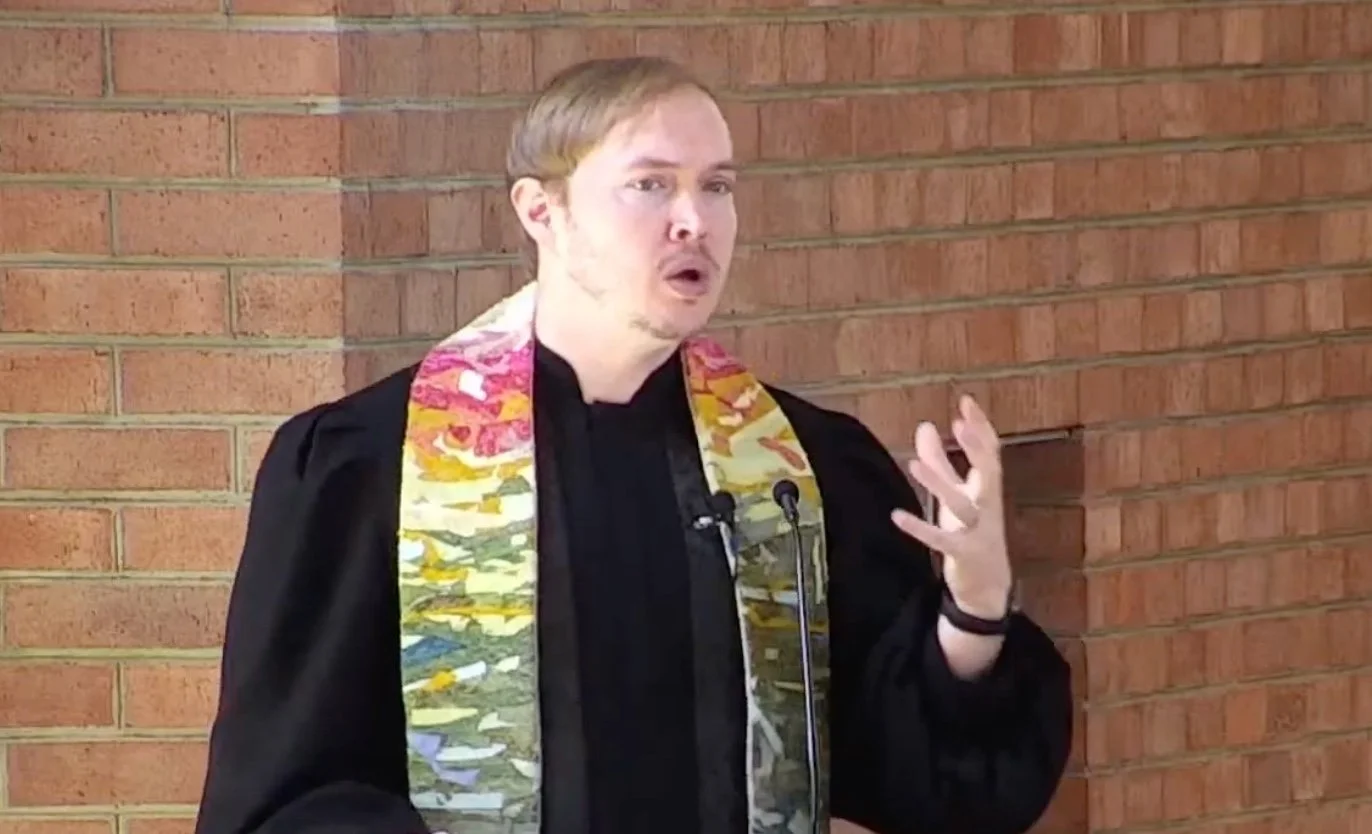
Sermon preached by Rev. Wesley King on Sunday, June 28, 2026
Good morning. Okay, so y'all know how there are different categories of movies. I'm not talking about genres. I'm talking about the movies that are so good, or they look so good, that you've got to see them right when they come out in theaters. There are movies that you're like, "Well, I could probably wait until it hits streaming before I see that one." And there's this third category of movie, the kind of movie that you're really only going to watch if you're stuck on an airplane. And that was me this week. I was like, fine, I guess I will finally watch the third installment of the Avatar franchise, Fire and Ash, as I flew to West Virginia earlier this week.
So, if you're unfamiliar with this franchise or this story, Jake Sully, who is a human marine, falls in love with this humanoid alien on the planet of Pandora, in which the humans have colonized and they've been terrorizing the natives there, these humanoids called the Na'vi. You fast forward through a couple of movies—sorry for some spoiler alerts here—and Jake Sully has given up his life as a human to live as the Na'vi because he's fallen in love with this woman. And so he and his wife have this beautiful, blended, and complicated family. There's Jake, who is the former human, he's the father. Neytiri, who is his wife, she's Na'vi. Their two sons, Neteyam, who unfortunately passes away in the movie prior, and Lo'ak, and their daughter Tuk. They also have this adopted daughter named Kiri, who is born of human and Na'vi, who is constantly reminded that she's different from the rest. And they've also taken in a human child named, or nicknamed, Spider. Neytiri, the wife, looks on Spider with disgust and resentment, as his people have destroyed parts of her planet, have killed her people, and have driven them to find somewhere else to live on the planet. Even though Spider is barely a teenager, is innocent, and has lived with the Na'vi his entire life, she looks on him with resentment and disgust. She looks on Kiri, the human and alien child, in a way that says, "I don't really know how to help you." All the while, she's still grieving the loss of her oldest son. And it makes their family dynamics in this story, in all three movies, uncomfortable and complicated. And it reminds me of this story in Genesis. She looks at Spider the way that I imagine that Sarah looked at Ishmael, as someone who, though innocent, represents all that had been taken from her and all that she was not afforded. Lo'ak, the younger son, feels like he's been discarded, and he contemplates leaving indefinitely.
These stories that we've been journeying through this month, they really aren't that ancient after all. But then we get today's story. A well-known story, but one that we often don't know what to do with. So before we dive into this text today, I'm wondering, I'm curious, what word is bubbling up for you. What word describes how you feel in this moment about this story? And I'd love for you to shout it out.
Evil.
Confused.
Any other thoughts? Any other words bubbling up?
Shocked. Yeah.
Holding all of these things, let's go to God in a word of prayer.
Holy God, be with us as we journey through this text. We're carrying these feelings of shock, of confusion. We see these evil acts in this story and we don't really know what to do with them. Give us the gift of discernment as we seek to understand this story today in all of its complexities. Amen.
So as we tackle this text today, I want to break it up into three different sections. First is how would the first listeners have understood this story. Next is how do we understand this story in 2026. And finally, what do we do with this story, this well-known story that we really don't fully understand even after we've heard it a million times.
So first, I think it's important for us to understand that this type of story is an archetype. It exists in all three of the Abrahamic traditions, Christianity, Judaism, and Islam. All three have a version where a chosen son is sacrificed or nearly sacrificed. Sound familiar? Carolyn Hessle and Song Park state that this story, also referred as the Akedah, which means the binding, like the binding of Isaac, is one of the most disturbing narratives in the Hebrew Bible, but it's also one of the most central narratives in the Hebrew Bible.
So I want you to remove your 2026 lens and put on this lens of antiquity. And I want you to remember the stories that we've gone through and journeyed through over the last four weeks. And I also want you to remember the following: Abraham was 75 years old when he received the promise that he and Sarah would build a great nation and that God would bless him and would make his name renowned. Seventy-five years old. He then had to wait another 11 years before Ishmael was born of Hagar, his concubine, his slave. He then had to wait another 14 years, when he was a hundred years old, for his first legitimate son. And that's a lot to unpack. But his first legitimate son, Isaac, had to be born, and in doing so had to turn away his other son, Ishmael, and Hagar. And then God asks him, after all this time, after a hundred years, to do the unthinkable, the unimaginable, the unfathomable.
And I can hear his inner monologue. It's not in the text, but I can hear his inner monologue in my head, and it sounds something like this. God, you cannot be serious. I have waited and waited and waited for this, my son to be born, my lineage, my namesake. I've watched Sarah's heart break time and time again, longing to bear a son. I've watched her resent Hagar and my boy, my precious boy, Ishmael. I've seen how she looks at them. I've seen how she looks at me. And then finally your promise is fulfilled, and he's strong and he's smart and he's beautiful, my boy Isaac, and now you want me to.
To ancient listeners, this was a story about commitment to following God and God providing. To ancient listeners who understood the importance of lineage, of having a male heir, of having a namesake, those who saw the high child mortality rates of their society, they would have understood how deep of a sacrifice Abraham was making. This was his son. The text says, "the son whom he loved," but it was also his name, his lineage, his status in his world, his heritage. And remember that these are stories that are told and retold orally and then written down, we think, by Moses, but really, who knows? And then told and heard by a people who are just trying to make sense of the world.
I think, and I invite you to come up with your own conclusion too, I think that they would have heard this story as a reminder that following God takes sacrifice, but that God will always provide. I think they would have understood this less about what God was asking of Abraham, but more so that despite all that Abraham had endured, that he was still willing to follow God and that God fulfilled his promise to Abraham and he provided.
I finished Avatar: Fire and Ash on the flight back to Nashville from West Virginia on Friday night. And there's this scene where Jake Sully takes Spider, his human son, or someone he counts as a son. And Spider had developed this ability, even as a human, to breathe the air on the planet Pandora. And Jake knows that if the humans get a hold of Spider, they will study him. They will figure out how to breathe the air on Pandora, and that will make them unstoppable from colonizing the planet and terrorizing and genociding the natives there, the Na'vi. And Jake thinks that the only way to save the Na'vi is to take Spider into the woods and sacrifice him. And so he takes him into the woods, he makes Spider kneel, and he draws his knife.
So, how do we understand this story in 2026? Because we don't live in antiquity. Human sacrifice isn't really a normal part of our society. Our children are important to us, yes, but they don't really determine our worth as a people or as a family. Well, I think we should be critical of this story. I think that's what we're called to do as listeners and hearers and readers of the word. So, I'm curious, what questions are bubbling up to you about this story? What's coming to the top?
Why?
Was he really going to do it?
How long was the ram there?
What does it foreshadow?
I have some questions too. Why did the text say that Abraham, or that Isaac, was Abraham's only son? Is that because he who holds the pen writes history? Are they writing Ishmael out here? Or is it because Isaac is his only son, because the writer knew that he had already sent Ishmael away? I'm curious about what Sarah thought about all this, because it's not in the text. It's not recorded. How did she feel after finally conceiving a son after 90 years, and after probably giving up the thought that it would ever happen? How did she feel when she had learned what had transpired? Would she see this as God providing, or would she feel betrayed by this?
Rabbi Dr. Cecil Gonlave provides a look into this, as she says that the biblical text practices narrative violence against Sarah. She completely disappears from the narrative of the Akedah. Abraham receives this divine command, but Sarah is neither consulted, nor informed, nor even mentioned in the story. This textual silence is a form of erasure that reflects the invisibilization of women in narratives produced by patriarchal societies. She's not informed. She's not mentioned. She's not consulted. Nothing. The Bereshit Rabbah, which is essentially a Jewish rabbinical commentary on the book of Genesis, offers this compelling image, as Sarah herself sets out in search of Abraham and Isaac. And it tells of her traversing the path to Mount Moriah. And this image of Sarah wandering, looking for her only son that she waited 90 years for, is poignant. The next chapter of our text does tell of her death, but the Bereshit Rabbah gives imagery to what our text leaves out. In fact, because Sarah promptly dies in the next chapter of Genesis, interpreters have often wondered whether her death was a result of Sarah's discovery of her husband's secret attempt to murder their child, the child that she spent her entire life waiting for. Also, following this story, we don't see Isaac speak directly to Abraham again. Perhaps it happened, it just wasn't recorded in scripture, but in the text, at least, it doesn't say anything about that. So, did this act tear their family apart?
With my 2026 lens, I'm also wondering if this is more so a testament to the fact that many people throughout human history have heard God say something and then they take actions towards violence or greed or power, and how convenient that can be. So what if this is a critique of when what God said is antithetical to the nature of who we know God to be? When what we hear God say is hurtful or harmful, and it doesn't reflect the nature of this all-loving, merciful, and gracious God that we read about. From the doctrine of discovery, where we colonize lands in the name of Christ, often killing or enslaving those who refuse to do so, Indian boarding schools, where we taught them the Bible but we beat their indigenous languages out of them, to today, when televangelists who heard God say send them some money over the TV so that they can be in turn blessed.
Yesterday at Pride, I stood with my dear friend Reverend Don Bennett. She'd been out there for a long time. I just kind of joined her at the end, and she was trying to block the street preachers, the ones preaching on the street, who were preaching fire and brimstone to the crowd as they entered the festival gates. And I truly think that they believe what they are saying. And I believe that they believe that they are being loving by helping folks with their truth and what God has called them to do. I truly believe that they believe that. But I also know that the messages that they were preaching are the same messages that make LGBTQ kids four times more likely to try and take their own lives. I know that the messages that they are preaching are the same reason that 39% of LGBTQ kids have seriously considered suicide in the last year. Their messages are the same reason that there were 372 suicides, homicides, and other acts of violence towards trans folks in general last year.
If what God is saying to us is to hurt or harm, even if that isn't our intention, maybe we are mis-sharing God. If what God is saying to us doesn't consult the closest to us who will be directly affected by our actions, then maybe we are mis-sharing God. When Jake Sully has his knife drawn and he's about to kill this child, this person who's going to become a son to him, thinking that this is the only way to save his people, he can't do it. And his wife, the one who once looked upon Spider with resentment, runs and saves him and says that there has to be another way.
We've been talking about Genesis for the last four weeks, about these complex stories that really aren't so ancient after all, about complicated family dynamics, and I think that we've barely scratched the surface. I think we could have spent the entire month on this text alone. But what do we do with these stories? I think we have to journey with them. I think we have to journey with them. There's a reason that we revisit these stories in the Bible every three years within the lectionary. There's a reason that these rabbis create this ongoing commentary, like the Bereshit Rabbah, on these ancient texts. It's because these stories aren't something that you just get the first time around. We have to journey with these stories, and these stories journey with us. And each time we hear them, we learn something new, or each time we ask a new question, or each time we better understand who God is.
Helil and Park speak about how, in Jewish tradition, Isaac, whose name means what? Yes. Thank you. Thank you.
Jewish tradition speaks about Isaac as a survivor. They choose to focus not so much on Abraham here, or Sarah, but Isaac as a survivor, as a model of hope. It's a testament that we too, no matter our traumas, our problems, our abuse, we can survive and we can live and we can laugh, as Isaac did. The Jewish tradition asks, "Why was the most tragic of our ancestors named Isaac, a name which evokes and signifies laughter?" And they say, "Here's why. As the first survivor, he had to teach us, the rest, and the future survivors of Jewish history, that it is possible to suffer and to despair an entire lifetime and still not give up the art of laughter and joy."
Friends, I feel like we have more questions now than we did at the beginning of this month, from when we started this sermon series four weeks ago. But the thing that has been made clear is that we are not called to journey through these texts, journey through this life, alone. We may not hear Isaac's voice in this story, but we are called into community so that we can listen for the voices that are so often left out. We have the opportunity to listen to the voices of people who've felt like their families chose their religion over them. So let this be a reminder to us that God loves each and every one of us, so much so that God called us good and has called us into community so that we may journey together and leave nobody behind. Journey through this life, journey through this world, journey through this work, together. That's what we've been called to do. So may it be so. And may we make it so with our actions and our loving. Amen.